Wild Porcini Orzo with Grilled Portobello Caps

Last year we picked hundreds of pounds of boletes — wild porcini mushrooms. We dried them and have since not consumed many of them; so before we hit mushroom season this summer we decided we better start using these earthy, flavorful morsels.

Wild mushrooms pair well with risotto. I had a half box of Barilla Orzo pasta, which look like grains of rice. I thought the orzo would taste super with portobello and porcini with a hint of lemon and garlic.

Costco sells a four pack of portobello caps for just a few dollars. I lightly marinated them in oil and vinegar then grilled them over high heat and topped them with roasted bell peppers and chèvre. The fresh arugula salad was the perfect accompaniment to the meal with a simple lemon vinaigrette.

This is a quick meal that’s hearty and vegetarian too.

Porcini Orzo with Grilled Portobello Caps and Baby Arugula Salad | Alaska Knit Nat

Wild Porcini Orzo with Grilled Portobello Caps and Baby Arugula Salad

Serves 3

Ingredients:

4 portobello caps

1 oz. dried porcini mushrooms

4 Tbs. butter

Olive oil

2 Tbs. apple cider vinegar

1 Tbs. balsamic vinegar

1 cup dry orzo pasta

2 cloves garlic

zest and juice of one lemon

1/4 cup Pecorino Romano cheese

1/4 cup crumbled chèvre

3 mini bell peppers

salt and pepper


Directions:

Bring a cup of water to boil. Pour over the dried mushrooms and cover. Set aside for 15 minutes. Remove the stems from portobello caps and set aside. Remove the gills with a spoon. Lightly score the tops of three of the caps with a paring knife. Reserve one cap for the orzo. Combine 1/3 cup olive oil, the vinegars, one minced clove of garlic salt and pepper to a one-gallon ziploc bag. Carefully add the caps, seal and gently toss to coat the caps. Let sit 30 minutes to an hour.

Chop the stems and one portobello cap. Remove the porcini mushrooms and reserve the liquid. Chop the porcini. Set aside.

Porcini Orzo with Grilled Portobello Caps and Baby Arugula Salad | Alaska Knit Nat

Bring a pot of water to boil and cook the orzo for 7 minutes. Drain and set aside. Lightly toss with olive oil so they don’t stick together. Meanwhile, heat the butter and one tablespoon olive oil in a large sauté pan. Add the chopped mushrooms and cook for about 5 minutes until some of the liquid has evaporated from them. Add the lemon zest and one minced clove of garlic. Cook for another couple of minutes, till garlic is fragrant. Add the orzo, 1/4 cup of reserved mushroom liquid and the juice of 1/2 lemon. Toss thoroughly and season with salt and pepper.

Set all burners on your gas grill to high and heat for 15 minutes. Chop the tops off the bell peppers and remove the seeds. Skewer them on a metal skewer. Turn grill burners to med-high and set the peppers and the mushroom caps, top side down, on the grill. Cover and grill for about 4 minutes. Flip and grill another 4 minutes. Remove everything from grill and slice the peppers. Serve the caps with sliced peppers and crumbled chèvre alongside the orzo, sprinkled with grated Pecorino Romano cheese.

Porcini Orzo with Grilled Portobello Caps and Baby Arugula Salad | Alaska Knit Nat

For the salad: Top baby arugula with sliced cherry tomatoes, blueberries and crumbed chèvre. Squeeze fresh lemon on top and drizzle on extra virgin olive oil. Season with salt and pepper.

Wild Salmon Caviar — a family recipe

Salmon Caviar | A Photo Tutorial

It’s salmon season and for most that means filets, steaks and smoked salmon. We love all that in our family, but as soon as we hear of a friend going salmon fishing we think “roe!” We request that all our fishing friends keep the salmon eggs when they clean their fish and store them diligently on ice until they reach our clutches.

I grew up knowing all about brined salmon caviar: they were stinky, fishy, gooey and gross. But then I grew up and so did my palate. Now they are glimmering orange jewels that pop and melt in your mouth in salty bliss.

My father is the king of salmon roe preparation, so I have decided to reblog his Caviar Mania post from his site sausagemania.com (it’s for real, people). Visit his site for full photo tutorials on preparing sausage, lox, kippered salmon, and pesto.

Fresh King Salmon Caviar

How to Make Delicious Salmon Caviar at Home. Easy Recipes From SausageMania.com!

The designation “caviar” is traditionally applied to the salted, unfertilized roe of wild Caspian Sea sturgeon, a rapidly diminishing resource as neither Russia nor Iran are able (or willing) to end poaching. While Russian and Iranian caviar is an expensive luxury, going for as much as $500 an ounce, lesser caviars, made from the salted roe of salmon, lump fish, whitefish, steelhead, trout and other species of sturgeon, are more affordable substitutes.

CaviarMania is here to teach you how to make Salmon Caviar, specifically, caviar from Wild Alaskan Salmon.

Salmon Caviar is ridiculously simple to make. The most difficult part is getting hold of fresh salmon eggs. Fortunately, here in Alaska, salmon eggs are often discarded, or rolled in Borax, frozen, and used as bait – to catch more salmon, of course. So during the salmon runs in June through August, fresh eggs can be had in abundance if you have the right connections.

If you do not, then you need salmon – fresh, whole, uncleaned, iced salmon, and then you hope most of them are hens, that is, full of eggs. You can do without the fish, if you can tap into a good supply of fresh eggs, which, in Alaska, the home of SausageMania, LoxMania, KipperMania and now, CaviarMania, can often be done if you have fishing friends who are wiling to save the roe for you. A word of caution, however: you must know and trust your roe purveyor to care for the roe. If the fish have been left in the sun for a few hours before being cleaned, or the roe is not immediately iced, you may find youself spending time, energy and salt to produce an inferior product!

Exposing the RoeTwo beautiful skeins of roe!


Removing Roe From a Female King Salmon
The roe is removed from the salmon.

A Bowl of King Salmon Roe

The only tools needed are a few bowls and a screen of 1/4″ or 5/16″ galvanized mesh to fit over one of the bowls, a large strainer and a 1-gallon ZipLoc bag. The only ingredients are the salmon eggs, salt and cold water. The most time-consuming part is pushing the eggs through the mesh. The brining time necessary to prepare the caviar varies from 10 to 30 minutes, depending on the size of the eggs and your tolerance for saltiness.

A few words of caution about salmon roe: handle the skeins with care. Keep them cold at all times. Never, never, never freeze salmon roe unless you’re planning to make fish bait. The same goes for the finished product: freezing wrecks the eggs, and is especially harsh on the sensual “pop-ness” of the individual eggs as you eat them. Fresh caviar has a unique texture: you can feel each separate egg on the tongue, and each egg pops with a flavorful explosion. Frozen caviar is “dead.” It’s slushy, slimy and inert.

OK, so now you have several skeins of fresh, cold salmon eggs from a reputable source. From which species of salmon? Eggs from sockeye (red) and pink (humpy) salmon are small, and require less brining time. Eggs from Coho (silver) salmon are larger and require more brining. Eggs from king (Chinook) salmon, and from chum (dog or keta) salmon are the largest, and need the longest time. (Keta eggs are prized by Russians, who feel they make the best salmon caviar.)

Whatever kind of roe you have, you will need a galvanized screen to separate the eggs from their membranous attachment. A galvanized mesh screen with 1/4 – 5/16” holes is the best; cut it to fit tightly over a large bowl. Then get hold of some non-iodized salt. Coarse is better than fine.

Spread each skein, membrane side up, on the screen and work the eggs through the screen and through the mesh with your fingers. Membranes will get caught in the screen, so every now and again, remove the stuck membranes and discard. From time to time, remove the screen, and gently scrape off the eggs hanging from the bottom with a rubber or plastic spatula.

Salt and Mesh For Making Caviar
ust one ingredient: non-iodized salt. Just one tool: a piece of galvanized mesh.
Pushing Salmon Eggs Through Mesh
A skein being positioned on the mesh. The skein will be rotated to put the egg membrane on top.
Pushing Salmon Eggs Through the Mesh
Push the eggs through the mesh.

Next, fill a large bowl with the coldest water you can get and dissolve enough salt in it until you have a saturated saline solution, meaning that there will be undissolved excess salt in the bottom. Pour the separated eggs into the cold brine and gently stir. Set a timer for 10 minutes.

After ten minutes, take a spoonful of eggs and place in a small strainer, then rinse them in running cold water to rinse off the exterior salt. Taste them. If not salty enough, wait another five minutes and taste again. When the eggs are salty enough for your taste, pour them into a large strainer and rinse them with running cold water, gently turning them over and over with your hands to wash off all the outside salt.

Soaking Salmon Eggs in Saline
Now put the eggs in a cold saturated saline solution for 10-30 minutes, depending on size of eggs and your taste for saltiness.
Rinsing Salmon Eggs
Once you’ve sampled the eggs, and gotten them to your level of saltiness, rinse in cold running water to remove surface salt.

At this stage, the eggs still have active osmotic cell walls, so, if you over-salted them, just soak them in cold water for several minutes, and the salt will travel back out of the eggs and into the water. Once you are completely satisfied with the saltiness of the product, place the egg-laden strainer in a large bowl and fill a gallon ZipLoc bag with cold water. Place the bag on top of the eggs and put the bowl with strainer, eggs and ZipLoc in the refrigerator overnight. The weight of the ZipLoc bag packs and compresses the eggs, which helps make them spreadable onto crackers or whatever you wish to spread them on. Now you have caviar! It will last 7-10 days in the fridge, after which it won’t spoil, but will acquire an unpleasant fishy taste. If you have a vacuum packer, you can vacuum-pack the jars, which will allow the product to remain decent from 2-3 weeks, if refrigerated, before becoming “fishy.”

Weighting Down Salmon Eggs
Weight down the eggs with a ZipLoc bag.


Salmon Eggs in Fridge
Store the weighted eggs overnight in the fridge.
Finished Caviar in Sink
The next day, the caviar is compacted.

Filling Jars with Salmon Caviar

A Pyramid of Caviar!

Punching a Hole in a Jar of Caviar

Unless you have a vacuum packer that will evacuate Mason jars, you’ll need to punch a hole in the tops of the jars to let the air out, and vacuum-pack them in bags. They will then keep in the fridge for up to three weeks.

Jar of Caviar in Vacuum Packe
Placing a jar of caviar in the packer.
Salmon Caviar in Refrigerator
The final product safe in the refrigerator.

Now that you’ve finished, what are you going to do with all that caviar? Well, it’ll go faster than you think. You can spread it on crackers, make Blini or Caviar Omelets (but don’t make them “hard” or you’ll ruin the caviar). If you make Blini, serve with iced vodka.

Blini made with Salmon Caviar
Preparing a plate of Salmon Caviar Blini. Blini are Russian pancakes, really the same thing as crepes.
Iced Stolichnaya Vodka
For the quantity of Caviar we just made, we’ll need a lot of Vodka!
Blini Made with Salmon Cavair - Ready to Eat!
Serve the Blini with a dollop of sour cream and some iced vodka. You’ll be surprised how quickly a quart of caviar goes!


Not yet brave enough for salmon eggs? Try my recipe for grilled cedar-plank salmon.


Flower Magic in the Midnight Sun

My best friend Kelly and I have a long past of frolicking through the Anchorage woods together. We frolic and collect. Sometimes it’s moss. Sometimes it’s branches, but most of the time it’s flowers.

One great thing about Alaska summers is the endless sunlight. Tonight we decided to go pick daisies on the side of the road. We set out at 9 p.m. By the time we completed a flower crown it was 10 p.m. and still plenty of light for a photo shoot.

Flower crowns are surprisingly easy. All you need is some floral wire, floral tape and small clusters of wildflowers. We used lilac, daisies, beautiful Jacob’s ladder and wild roses.

No tutorial today, but I just wanted to show off my beautiful friend.

Wildflower crown | Alaska Knit Nat Wildflower crown | Alaska Knit Nat Wildflower crown | Alaska Knit Nat Wildflower crown | Alaska Knit Nat Wildflower crown | Alaska Knit Nat Wildflower crown | Alaska Knit Nat Wildflower crown | Alaska Knit Nat Wildflower crown | Alaska Knit Nat Wildflower crown | Alaska Knit Nat Wildflower crown | Alaska Knit Nat Wildflower crown | Alaska Knit Nat

How to Cook Perfect Beans

Taco night is always a big hit in our family and one of the most requested ingredients from our son is beans. Sure, canned beans are convenient and inexpensive, but there’s often a bit of sodium in them and when you reheat them, they can easily be overcooked.

Many are hesitant to cook dry beans due to lack of experience and convenience, but with a little planning and minimal effort, you can easily cook creamy, flavorful beans to accompany many food genres. And they are much cheaper than canned beans!

How to cook perfect beans | Alaska Knit Nat

Perfect Beans

Makes about 3 cups

Ingredients:

One cup of dried beans such as pinto, great northern or black

1 Tbs. salt

water

How to cook perfect beans | Alaska Knit Nat

Directions:

The morning you want to have beans for dinner, toss your dry beans into a mesh strainer and rinse with cold water. Add beans and salt to a medium saucepan. Fill with water so pan is about 2/3 full. Cover and let sit all day, about 7-9 hours.

Put pan on stove, still covered, and bring to a boil. Reduce heat and gently simmer beans for 1.5-2 hours. Be sure it’s not at a full rolling boil as the beans can get torn up if overly disturbed. Drain and serve.

*Beany tidbit: If your beans appear shriveled after soaking them it means they are past their prime. They will still taste all right but you may want to buy new beans next time.

How to cook perfect beans | Alaska Knit Nat

Guest Post: Fan and Feather Lovey — Free Pattern

Today I have the honor of hosting a pattern by the ever-so-lovely Annie Ciszak Pazar, owner of Anchorage’s Bella Boutique and author of the crafty blog Annie’s Arts and Follies.

I’ve always admired this lady for her unique jewelry and undying motivation for knitting big ol’ scarves and cowls.

Recently a mutual friend of ours had a baby — today actually! I felt like there was no better day to showcase the stunning blanket Annie made for her new little girl. So I’ll hand it over to Annie:

I have a blanket on my bed which I affectionately call Lovey. Lovey was a gift from my grandmother at my mother’s baby shower for me, 30-some years ago. Lovey is still around. And on my bed. Needless to say I have a very tolerant husband and perhaps some slight attachment issues. So when it comes time to make special soft and cuddly things for my friend’s little ones, I choose the Lovey pattern – also known as Fan and Feather for those in the biz.

Fan and Feather Baby Blanket | Free Pattern

The first blanket I made was for my friend Jeni when she was expecting her second little one, Robert, as she and I have known each other for 97% of our lives – so it was only fitting she have a Lovey too.

Fan and Feather Baby Blanket | Free Pattern

(Left: my Lovey in 2011. Right: Robert’s Lovey)

  • Using a US6 (4mm) needle cast on a multiple of 18 stitches + whatever you want for a border, but at least 1 stitch on either end (I add 10 – 5 on each side).
  • Knit 10 rows
  • Assuming 5 stitches at each end, work the following 4 rows until you reach desired length:
  • Row 1: knit
  • Row 2: purl
  • Row 3: k5, * k2 tog 3 times, (k1, yo) 6 times, k2 tog 3 times * repeat from * to * until last stitch, k5
  • Row 4: knit
  • When you have reached desired length, knit 10 rows to finish border. Weave in ends.

Fan and Feather Baby Blanket | Free Pattern

This latest blanket is for a local fab lady who keeps me in popsicles all summer on her funky custom PopCycle bike complete with cooler sidecar. I worked on this one from Alaska to New York and back again, and find it only appropriate that it already be travelling as the parents to be met while exploring the world in another country.

This is a super easy and rather fast pattern which looks more complicated than it is. In a bout of bravery I entered one in the Alaska State Fair 2 years ago and brought home a green ribbon and honorable mention in the baby blanket category. But what it really comes down to, is my hope that the kiddos for whom I make these little Lovey’s, love them as much as I love mine (or maybe a little less – there’s that attachment thing…).

Want to see more of Annie’s work? Check out her Etsy store!


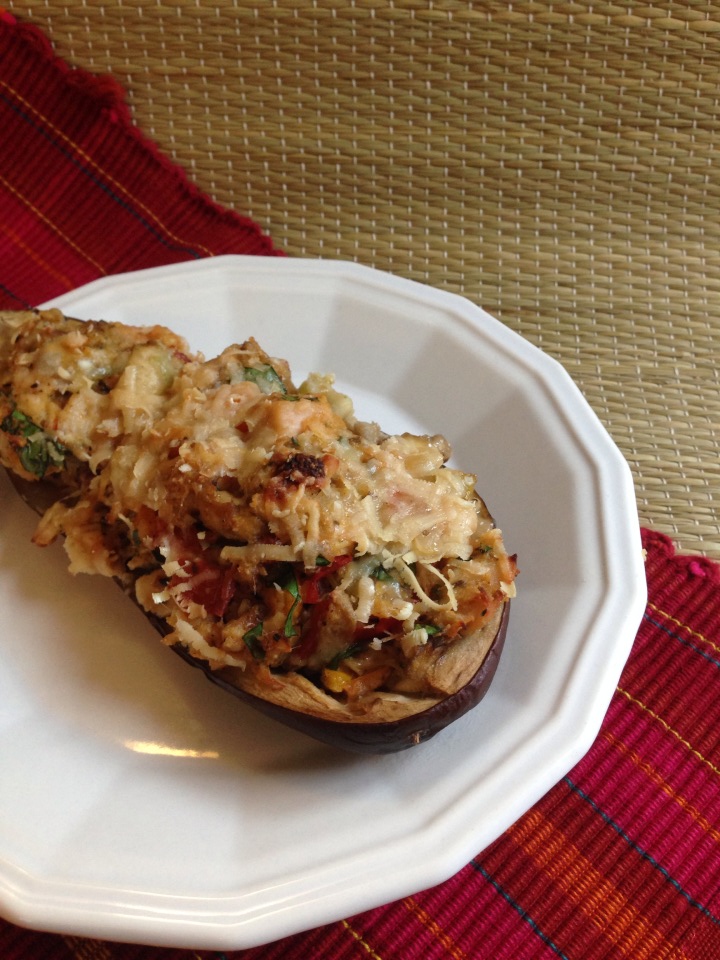
Chicken-stuffed Eggplant

Eggplant is a foreign food to me. I’ve only cooked with it once before when I made eggplant parmesan a long time back. They looked so irresistible today at Costco — so purple and shiny without a single flaw. I added a $5 rotisserie chicken, mini heirloom tomatoes and mini bell peppers to my cart and knew I’d be able to throw something together.

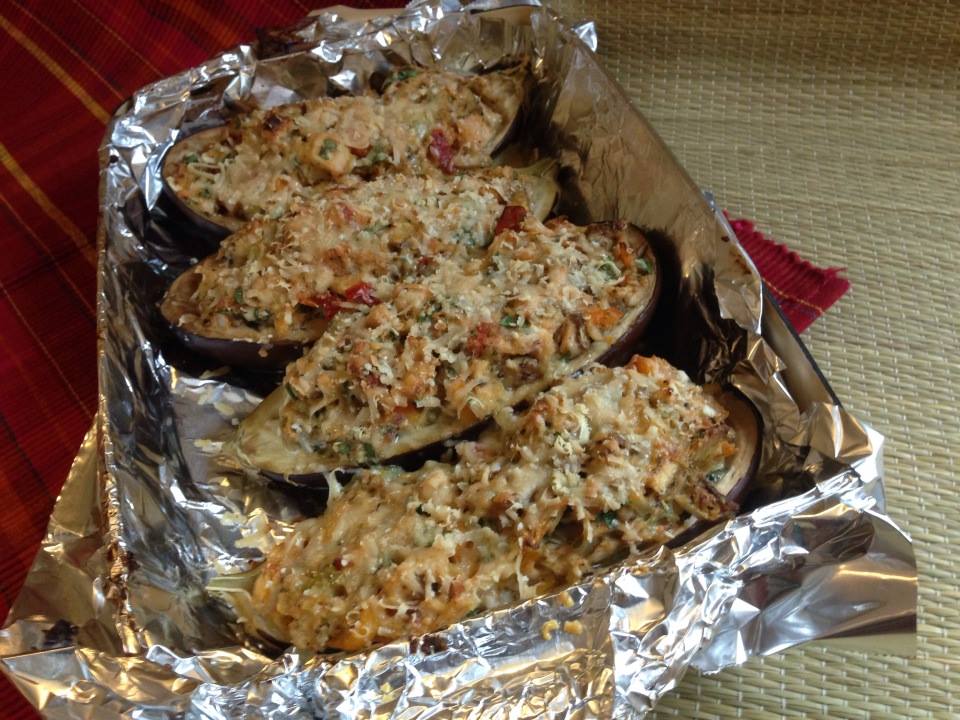
I made stuffed eggplant almost like a meatball recipe. They turned out flavorful and not too soggy, thanks to a quick technique inspired by America’s Test Kitchen.

Chicken-stuffed Eggplant | Alaska Knit Nat

Chicken Stuffed Eggplant

Serves 2-3

Ingrdients:

2 medium eggplants, sliced down the middle

2 Tbs. olive oil

1/2 onion, chopped fine

3 mini orange and yellow bell peppers, chopped fine

1/2 stalk celery, chopped fine

1/4 cup diced tomatoes

3 cloves garlic, minced

2 tsp. dried basil

1 tsp. dried oregano

1/2 tin of anchovies, minced (about 3 filets)

1 egg

1/2 cup cooked chicken, diced

2 Tbs. fresh parsley, chopped

3 Tbs. Italian breadcrumbs

1/2 cup parmesan cheese, grated

salt and pepper to taste

Chicken-stuffed Eggplant | Alaska Knit Nat

Directions:

Carefully scoop out the flesh of your eggplants without breaking the skin. Chop the flesh into small pieces. Lightly salt the flesh and hollowed out eggplants. Place eggplant shells in a foil-lined casserole dish and set aside.

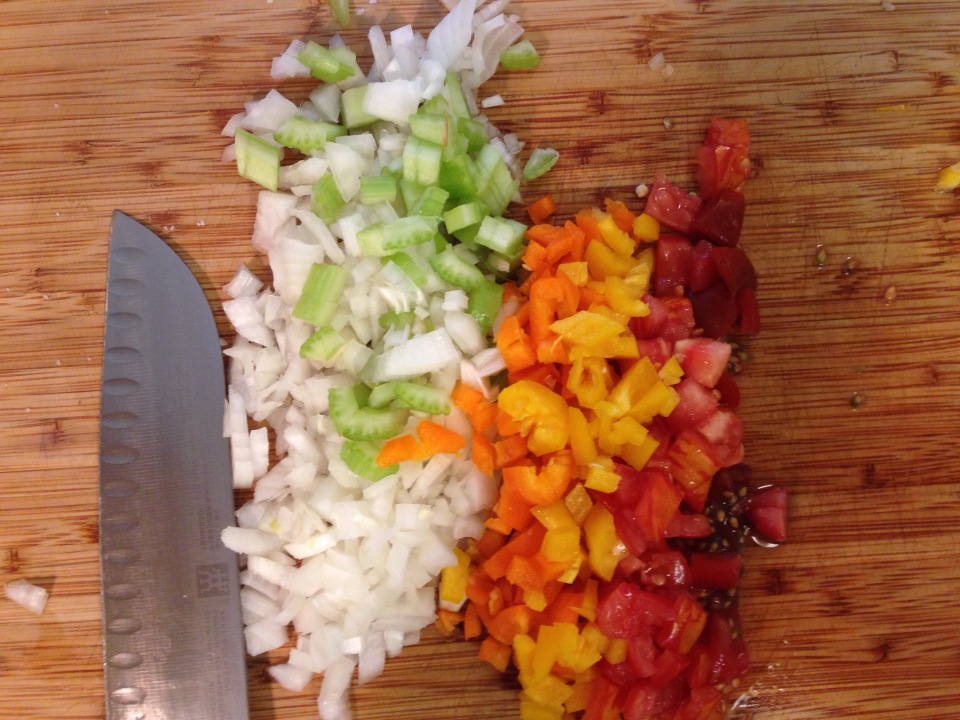
In a saute pan, heat the olive oil over medium-high flame. Add the onion, peppers, celery and tomatoes and cook till onions are soft, about five minutes. Add the garlic, basil and oregano and cook another two minutes.

In a mixing bowl, combine the egg, chicken, anchovies, parsley, breadcrumbs and sautéed vegetables. Place the eggplant flesh in a microwave safe bowl and microwave for 30 seconds. Pat dry with a paper towel. This removes excess liquid from the eggplant and makes the filling less soggy. Add the eggplant to the mix and salt and pepper to taste. Add 3 Tbs. of parmesan cheese, mix well and add filling to the eggplant shells. Lightly press the filling and create small mounds in the shells if needs be.

Sprinkle liberally with parmesan cheese and bake for 45 minutes or until browned.

Serve with brown rice.

Chicken-stuffed Eggplant | Alaska Knit Nat

Crustless Breakfast Quiche

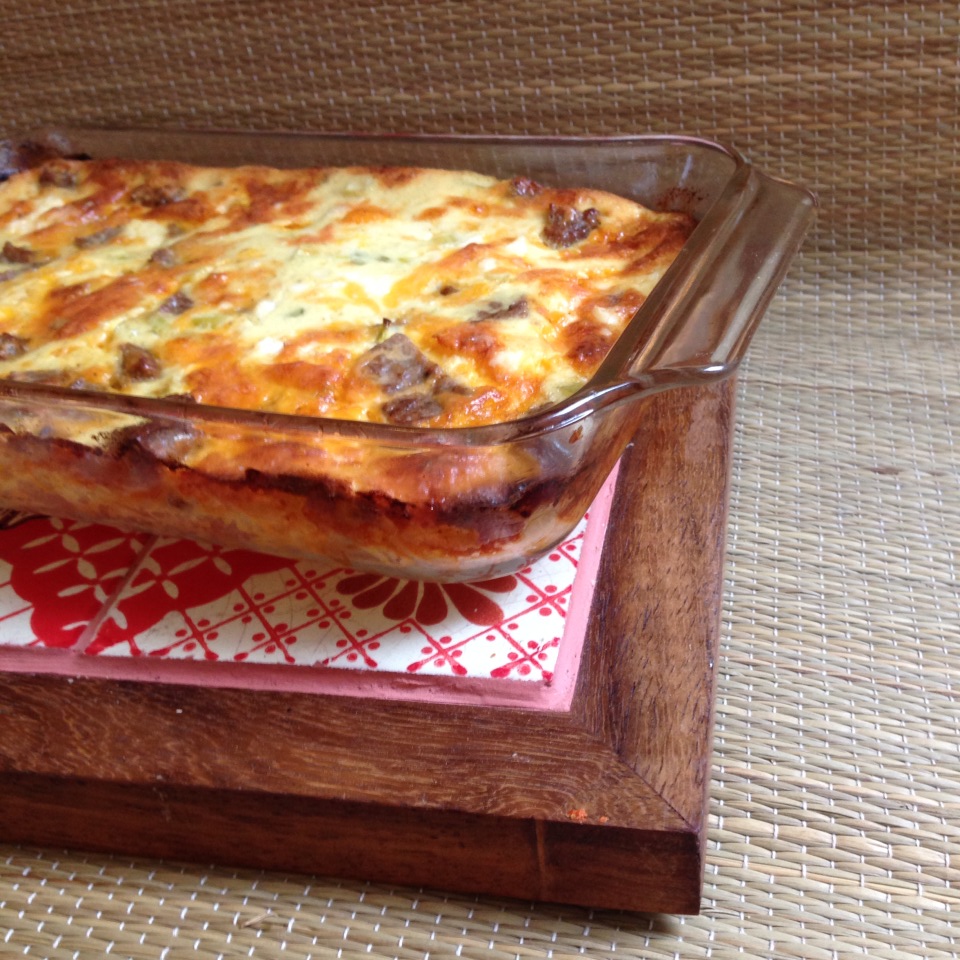
I had a hankerin’ for a fancy type breakfast this morning. I thought a quiche would be nice, but I didn’t want to make a crust or use a ton of butter. I found this tasty recipe and decided to tweak it slightly. I’ve never made a quiche, but whatever I concocted this morning was cheesy, salty, creamy and darn delicious. It’s also South Beach Diet friendly!

Crustless Breakfast Sausage Quiche | Alaska Knit Nat

Crustless Breakfast Quiche

Serves 3

Ingredients:

2 eggs

1/2 cup milk

1/3 cup plain Greek yogurt

3 oz. Neufchâtel cheese, cubed

4 breakfast sausage patties

2 green onions, chopped

1 cup grated cheddar cheese

pepper to taste

butter

Crustless Breakfast Sausage Quiche | Alaska Knit Nat

Directions:

Grease a small casserole dish liberally with butter. Preheat oven to 350 degrees. Fry up the breakfast sausage patties. Once browned, cut into bite-sized pieces.

Mix together the milk, eggs and yogurt. Add in the cheeses, sausage and green onions. Add pepper to taste. Pour into casserole and bake for one hour till browned and bubbly on top. Let cool for five minutes before serving.

The best part was the little pockets of cream cheese with every bite.

Crustless Breakfast Sausage Quiche | Alaska Knit Nat

Thrift Store Skirt Refashion — Free Tutorial

Floral prints are all the rage these days and I’m always finding skirts at the thrift store that have pretty patterns, but they are just too long for my stumpy legs.

You’ve probably come across these types of skirts — they are from the ’90s, ankle-length and look as though a church lady might wear them.

If you have basic sewing skills it’s pretty simple to shorten a skirt to a more youthful length. It only took me 45 minutes and I went from bake sale mom to hipster mom for $2.50. You can too!

Thrift Store Skirt Refashion -- go from bake sale mom to hipster mom in less than an hour!

Materials:

One thrift store skirt in your size

Ruler

Straight pins

Chalk or pencil

Fabric scissors

Sewing machine

Iron

Thrift Store Skirt Refashion -- go from bake sale mom to hipster mom in less than an hour!

Step 1: Iron your skirt if it needs it.

Step 2: Determine how much length you’d like to cut off. I wanted the skirt to fall just above my knees, which was about 10.5 inches from the original hem. I subtracted 1.5 inches to account for the new hem. For me, 9 inches was how much I needed to remove.

Thrift Store Skirt Refashion -- go from bake sale mom to hipster mom in less than an hour!

Step 3: If your skirt has buttons down the front, unbutton it and lay it flat, wrong side up. With a ruler and chalk or pencil go along the bottom of the skirt and mark 9 inches all around. I didn’t do this accurately at all and it still worked out fine. My skirt had a slight arc to it so I eyeballed it here and there.

Step 4: Cut along the measurement lines you made.

Thrift Store Skirt Refashion -- go from bake sale mom to hipster mom in less than an hour!

Step 5: With your iron, turn under 1/2 inch from the edge all across the skirt.

Thrift Store Skirt Refashion -- go from bake sale mom to hipster mom in less than an hour!

Step 6: Turn under 1 inch all around and iron down, pinning as you go. *NOTE* if your skirt buttons in the front, make sure your ends match in the front. Mine were really off so I had to re-iron and eyeball it till it worked. Doesn’t need to be perfect, especially if it’s a flowing skirt. No one will notice if the back is slightly shorter than the front.

Thrift Store Skirt Refashion -- go from bake sale mom to hipster mom in less than an hour!

Step 7: Sew a seam along the hem 3/4 inches from the folded edge, backstitching at the beginning and end.

Step 8: Trim all threads and run an iron along the hem one last time.

Step 9: Put on your skirt and admire your crafty awesomeness.

Thrift Store Skirt Refashion -- go from bake sale mom to hipster mom in less than an hour!

Free knitting patterns, DIY crafts, easy recipes and more!