Category Archives: Patterns

Jazz Baby Hat

My friend Blaze is about two weeks ahead of me in her pregnancy. She had a boy last year she named Lyric and she’s getting ready to have a girl whom she is calling Jazz. Can you guess she’s a singer? 

With a name like Jazz I thought I should knit her a baby hat with some real flair. None of this pale pink stuff — I’ve got to go purple and red!

And I’ve finally learned to crochet a flower. This was the original reason I taught myself to crochet and that was almost two years ago. I now have the skills to make one without referring to a pattern. I will try to write out how I made it.


Materials:
Worsted weight yarn (I used Vanna White yarn)
Size 8 double point needles (or a really long circular if you know the Magic Loop method)
Size H crochet hook (it could be smaller, but I only have two sizes)
Darning needle

Directions for hat:
Cast on 64 stitches. K1, p1 ribbing for 5 rounds
Knit in stockinette stitch for 25 more rounds, or till piece is about 4 inches tall.
Decrease as follows: *K2tog, k6*, repeat till end of round.
K 1 round
*K2tog, k5*, repeat till end of round.
K 1 round
*K2tog, k4*, repeat till end of round.
K 1 round 
*K2tog, k3*, repeat till end of round.
K 1 round
*K2tog, k2*, repeat till end of round.
K 1 round
*K2tog, k1*, repeat till end of round.
*K2tog*, repeat till end of round.

 
Cut yarn leaving a 12-inch tail. Weave ends through remaining eight loops using a darning needle. Weave in end yarn.
 
Crochet flower: 
I apologize for my poor pattern writing skills. I hope you are able to figure it out! Maybe tomorrow when I have daylight again I’ll take step-by-step photos.
 
Abbreviations:
SC = single crochet
HDC = half double crochet
DC = double crochet
Round 1: Make a magic ring and SC 10 stitches into ring. Join with slip stitch to first SC. 
Round 2: Chain 5, skip a stitch, slip into next stitch. Repeat four more times and join to first SC again. You should have five loopy things.
Round 3: SC once into first loopy area, then 2HDC, 1DC, 2HDC and 1 SC into same loopy area. Repeat with four remaining loops. Join to original SC.
Round 4: Skip one stitch from the first round and slip stitch into the stitches between the ones you single chained in round 2. Chain 8, skip stitch, slip into next stitch, chain 8, skip stitch, continue around till you have five new loopy things. Join with first slip stitch you made in this round.
Round 5: 2SC into first loopy, 2HDC, 3DC, 2HDC, 2SC into same loopy thing. Repeat with the remaining four loopy things. Cut yarn leaving a ten-inch tail and draw through the last loop. Weave in ends to back of flower. 
Using a darning needle sew the flower in place.


Chunky Braided Winter Headband

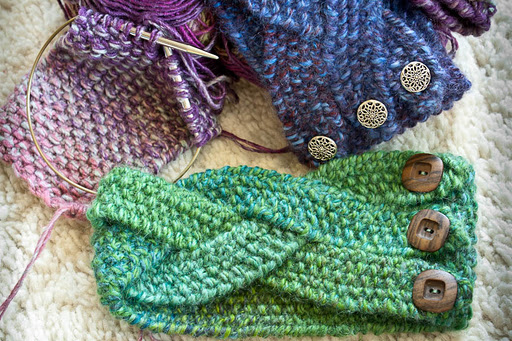
Last year I posted a pattern for a braided winter headband. After making one for myself, my mom and my little sister I soon realized it was the most popular knitted item I’ve ever created. The problem is, I’m really lazy and unless I’m determined, I really hate making these headbands. It’s simple, any beginner knitter could do it, but it takes too long and I lose interest.

I decided to try the pattern on larger needles with thicker yarn. Turns out I actually prefer the pattern this way. It goes by much more quickly and the texture stands out more strongly.

I’m still pretty lazy and can’t get myself to produce enough to sell, but I thought I might as well post my pattern so I don’t forget how I made it (hence the whole reason I started this blog in the first place).

If these instructions aren’t clear enough, you can always look at my other pattern for a slightly different explanation.

If you’re wanting to knit this pattern with a different needle size and different weight yarn, I am unable to adjust the pattern for you. This pattern is written for a specific needle size and yarn weight.

Materials:
2 skeins of worsted weight yarn (you’ll be knitting them together) OR one skein of bulky yarn
size 10 double point needles
darning needle
three attractive buttons
needle and thread
straight pins

Directions:
Using two double point needles, cast on 24 stitches. Knit in seed stich (also called moss stitch) till piece measures 12 inches. I always slip the first stitch of each row to keep the edge even.

*Next row: seed stitch the first 8 stitches onto an empty double pointed needle. Work back and forth on this “leg” for 12 inches.
Next row: k2tog, seed st. 3 stitches, k2tog
Next row: K2tog, k2tog
Bind off next row*

Repeat * for each of the two remaining “legs” of the headband.

Finishing:
Weave in the first tail of yarn.

Braid the three “legs” of the headband till there’s about 2 inches left at the ends. Pin the three ends to the beginning of the piece, creating the headband shape. Make sure the ends overlap the beginning of the piece so there’s a good amount of space for the size of your buttons.

Pin the braid in place. With the darning needle, secure each end in place using the tails from the “legs.”
Turn headband inside out. With needle and thread, whipstitch parts of the braid so the “legs” are secure and don’t move or twist apart when stretched.

Sew on your buttons.

Blue Starlight Sideways Scarf

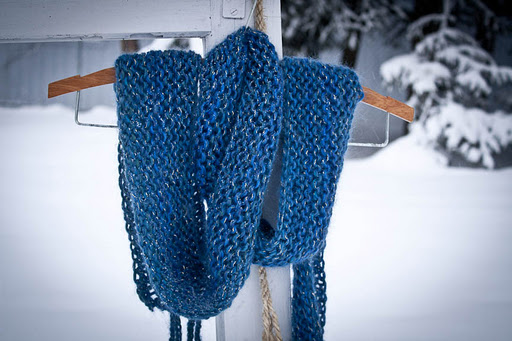
I’ve been admiring a scarf we sell at work, the Zumi scarf by Prana.

I like how it’s make the long way instead of the short way, how most scarves are made.

I figured it would be easy enough to make and it surely was. It was a great winter Sunday project.

Materials:
One ball of soft worsted weight single-ply yarn. I used Universal Yarn Classic Shades in the blue.
One ball of mohair in a similar color. I used some donated yarn that had silver glitter thread in it.
A really long size 13 circular needle
A size J crochet hook

Directions:
Loosely CO 150 stitches. Knit in garter stitch till work is 4-6.5 inches long, whichever you prefer. Loosely bind off.
For the tassels: Using the crochet hook, single chain four pieces of cord 12 inches long. Tie knots at the ends of each cord. Loop two to each end of the scarf.

Cheery Winter Set Patterns

If you’re wanting to knit this pattern with a different needle size and different weight yarn, I am unable to adjust the pattern for you. This pattern is written for a specific needle size and yarn weight.
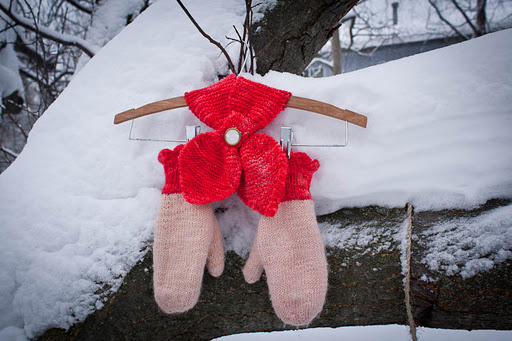
These items were made with heavy worsted hand-dyed single-ply yarn.
The hat is a simple pattern. Seventy-two stitches on size 9 circular needles. K1, P1 rib for six or so rows and knit in st st for 7 inches. Decrease as follows:
Place marker. *K2tog, K 6*, repeat to end of round
Knit one round
*K2tog, K5*, repeat to end of round
Knit one round
*K2tog, K4*, knit to end of round
Knit one round
*K2tog, K3*, repeat to end of round
Knit one round
*K2tog, K2*, knit to end of round
Knit one round
*K2tog, K1*, knit to end of round
*K2tog*, repeat to end of round
Draw loops together and weave in ends. Add awesome pom-pom.
Click here for the ascot pattern

For the mittens I used the Magic Loop method of knitting. It really made the project go by fast. If you don’t have any really long size 7 circular needles, then just use double points. For the cuff, use size 5, but don’t forget to switch out. I had to undo half a mitten when I realized it was coming out smaller having forgotten to change to size 7.

CO 36 stitches on smaller needles. K1, P1 rib for 28 rows or until preferred length. M1 stitch four times evenly over the next row (40 st).
Change to bigger needles and other color if making bi-colored mitts. Knit 6 rounds even.
Thumb gusset:
Round 1: M1, K1, M1, knit to end of round
Round 2 and all even rounds: Knit
Round 3: M1, K3, M1, knit to end of round
Round 5: M1, K5, M1, knit to end of round
Round 7: M1, K7, M1, knit to end of round
Round 9: M1, K9, M1, knit to end of round
Round 11: M1, K11, M1, knit to end of round
Round 13: M1, K13, M1, knit to end of round
Knit 5 rounds
Thumb hole: Place the first 15 stitches onto a stitch holder or scrap piece of chunky yarn. CO one stitch and knit to end of round (40 st).
Knit in st st till the piece is 1/2 inch shorter than the top of your middle finger.
First decrease round: *K2, K2tog* repeat to end of round
K 2 rounds
Second decrease round: *K2tog, K1* repeat to end of round
K 1 round
Third decrease round: *K2tog*, repeat to end of round
Repeat the last round or you should have about 12 stitches.
Use the Kitchener stitch or just draw up the stitches and weave in ends.
For the thumb:
Place the 15 stitches onto two double points or on your long circular if doing magic loop.
Pick up and knit four stitches, knit to end of round.
On next round, decrease two stitches evenly.
Knit 4 rounds
Next round: K2tog, knit to end of round. You should have 16 stitches, but it’s ok if you don’t.
Knit in st st till it’s as long as your thumb.
Decrease round: *K2tog* till end of round. Draw up yarn and weave in all ends.

Now make one more so you have two mittens to warm both hands!

To make a lining:

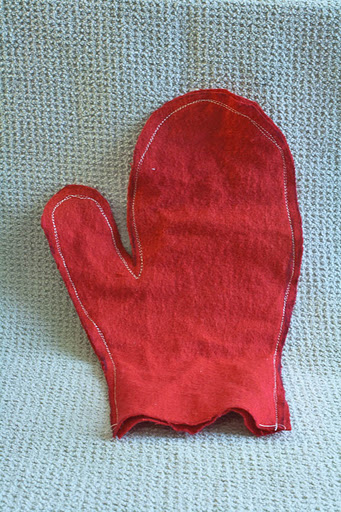
Trace the outline of the mitten to a pice of flannel doubled over. Add two inches to the tracing and cut out. Sew double seams all around the flannel mitten. You must make sure you can easily put on the flannel mitten, especially in the wrist area. I had to try a couple of times to get a good fit. Make two and hand sew into the mitten inside-out because that way the raw seams will not be on the inside of the lining.
Baby Beckham Set

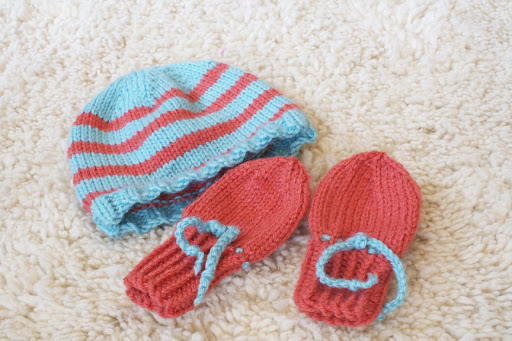
I have recently reunited with a high school friend via Blogland and we’ve been having a good time exchanging ideas and knowledge. She’s expecting a baby boy so I sent her a little hat and mitts set.

**Click HERE for the mitten pattern**

The pattern for the Stay-Put Mitts are from Sknitty.wordpress.com. I found it on Ravelry. They knitted up quickly and I really liked the twisted rib stitch on the cuff.

The pattern for the hat is as follows:

Worsted weight yarn, a skein of each color (you don’t need a whole skein)
size 7 circular needle
size 7 double points
darning needle

Cast on 64 stitches in your main color (MC). Connect the last stitch to the first being sure not to twist your work. Place a stitch marker if you need to. Make a rib of k2, p2 for five rows. Knit 3 rounds of contrast color (CC), then 4 rounds of main color. Either cut the yarn each time you change colors (leaving a six-inch tail), or carry up the yarn when you need to use it. If you do this, don’t pull too tightly when you bring in the next color or else it will make a gap in your work. *K 3 rounds CC, K 4 rounds MC* two more times. K 3 rounds CC and cut yarn leaving a six-inch tail. Knit 1 round MC and begin decreasing as follows:
*K2tog, k6*, repeat till end of round.
K 1 round
*K2tog, k5*, repeat till end of round.
K 1 round
*K2tog, k4*, repeat till end of round.
K 1 round. While doing this, transfer to the double points as you go so there are about 14 stitches on each needle (four in all).
*K2tog, k3*, repeat till end of round.
K 1 round
*K2tog, k2*, repeat till end of round.
K 1 round
*K2tog, k1*, repeat till end of round.
K 1 round
*K2tog*, repeat till end of round.
Cut yarn, leaving a long tail and with darning needle, run the yarn through the rest of the stitches and pull shut. Weave in all ends.

Cotton Candy

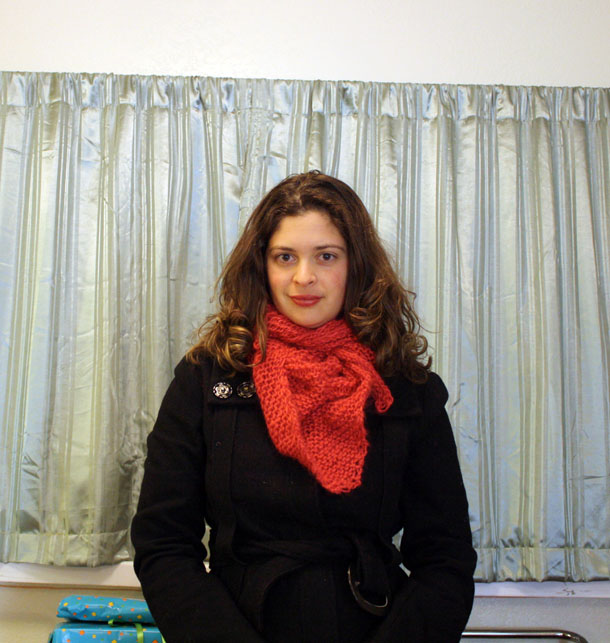
Pickles has done it again — inspired me to make something different and awesome. Springtime is right around the corner, but for us Alaskans, this time means anything from sunny cold days to whipping wind. Nothing is more appropriate than the Simple Luxury Scarf (or as I’m calling it, the Cotton Candy). It’s light and airy, delicate and soft. It’s perfectly bulky and squishy.

I used a combination of Cascade Yarn’s acrylic aran and some Rowan mohair/silk combo. The affordable price of the Cascase made up for the expensive mohair.

I learned my lesson on this project never to buy cheap needles. I bought some long, plastic 15 circular needles the other day and this was my first time using them. They broke halfway through my project. Thanks to a shoddy hot glue gun, I was uncomfortably able to finish, and I am happy I did.

Pickles’ pattern is pretty straightforward. I have yet to understand grams instead of meters or yards. I used one 100g ball of Cascade, about 240 yards, and one 25g ball of mohair, about 220 yards. The pattern calls for two 50 g balls of mohair but the 25g ball was perfect for my one ball of aran. I only had about 12 inches of mohair left when I finished the project. The other thing that wasn’t really explained was the reason for the final K3M1 row. I wasn’t sure if it was M1F like I’d been doing the whole time, but I just did a regular make one and it created a pretty decorative edge.

Definitely a project worth doing again and again.

T-shirt Baby Pants Tutorial

I woke up at 7 this morning and couldn’t get T-shirt baby pants off of my mind. So I made some T-shirt baby pants. And here is a step-by-step guide so you can make them too. This pattern includes a reverse applique heart. You can leave it out if you like, but it adds a little flair to these cute little pants.

First, download the pants pattern from Make-baby-stuff.com. I made the 0-3 mos. pattern.

Materials:
One large T-shirt with no seams on the sides
One extra shirt of contrasting color (for reverse applique)
About a foot of 1/2-inch wide elastic
Sewing machine
Stretchy material needle (this will make everything MUCH easier)
Straight pins
One safety pin
Chalk or washable fabric marking pen
Fabric scissors

Directions:
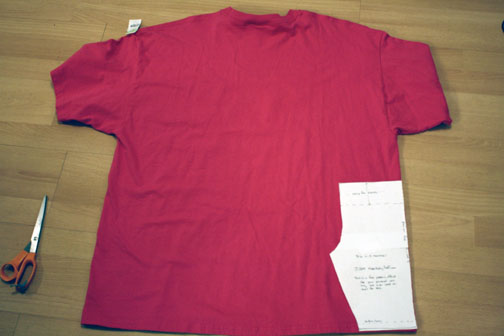
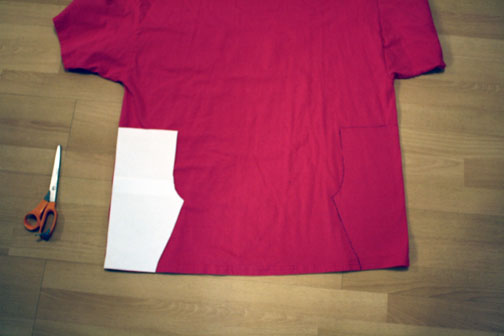
Lay out your T-shirt flat and trace your pattern on either side.

Make sure the pattern’s leg holes are flush with the bottom of the shirt. This will make it so you don’t have to hem the pants. Be sure the bottom hem lines up on both sides before cutting.

Next, cut a shape from a piece of paper. I made a heart about three inches tall. Cut a piece of fabric from the contrasting shirt that’s an inch bigger than the shape on all sides.

Next, trace the shape onto the pant leg using chalk or washable fabric pen. I put mine on the front panel (there is no front and back to each leg, so it doesn’t matter which side.) Pin the contrasting piece behind where you want the shape to be, on the wrong side of the fabric.

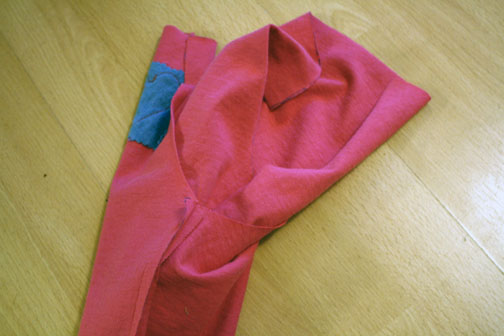
Sew along the trace marks and backstitch just slightly so it doesn’t unravel. Carefully pull the two fabrics apart and cut away the main color so the contrasting color shows. Trim to your liking.

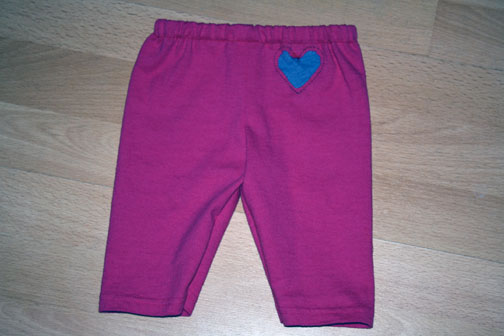
As you can see, I could have placed the heart farther down, but oh well. It was my first try!

Now you’re going to sew the inseams of each leg. That’s the straight edge you cut from the pattern. We’ll worry about the curved edge in the next step. Make sure you sew the legs with the right sides together.

Here’s the fun trick of this pattern — Take one leg and turn it right side out. Slip this leg inside the other leg (which is still inside out) and pin the curved edges together.

Pin the curved edge so that the seams you just made match up in the middle on both sides. This is the front and back crotch seams. You’re going to just sew along the curved edge. You may want to sew another stitch to reinforce this seam.  After you sew the crotch, take the inside leg out. Your pants should now be inside out. If one leg is right side out and the other is inside out, you didn’t make sure the right sides of the legs were together when you sewed the crotch.

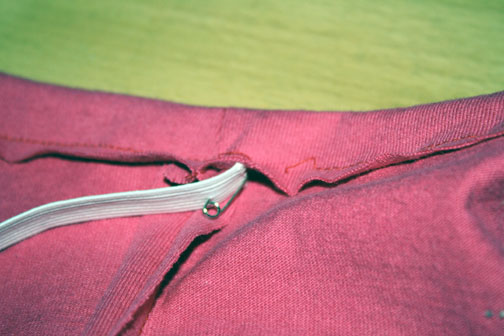
Next step (no photo since it’s easy), turn down the waistband about an inch and sew all the way around the waist, leaving a 1-inch hole in the back (the opposite side from the heart shape) so you can thread the elastic.

Attach a safety pin to the end of the elastic and feed it through the channel you just made.

Make the elastic as tight as you see fit (I honestly don’t know baby waist sizes. I just judged it by how it looked). And zig-zag stitch the elastic together, trimming the excess elastic.

Sew up the 1-inch hole, making sure to back stitch. Turn your pants right side out and TA-DA!

Pants!

Old T-shirt becomes baby pants!

I’ve been trying to think of things to make my best friend for her soon-to-be baby. I found a web site called www.make-baby-stuff.com that has a printable pattern for sewing baby pants.

Making pants is actually quite easy. You only need to cut out one piece for the pattern and with the right technique you can literally sew four seams and you have pants.

I decided to try and make some out of an old Patagonia t-shirt of my husband’s. I forgot to take a “before” photo, but here’s the “after”:

By using the hem of the t-shirt for the bottom of the pants, I didn’t have to hem them up. I made sure to use a needle that’s best for stretchy material and be sure to stretch the fabric a bit as you sew, that way the seams won’t bust when you stretch the pants later on. I added a ruffle made from the hem of the sleeves. I’m happy about this first try! I think I’ll go to the thrift store right now and find some good T-shirts to cut up.

Kasandra Gloves

My friend Kasandra requested a pair of long, fingerless gloves because her classroom gets really chilly in the winter. I decided to alter my Cabled Gauntlets pattern for her.

I used the same yarn, Universal Yarn Classic Shades, but there were a couple of things I did differently. First, I cast on 37 stitches instead of 36. This way the moss stitch is created without having to change the pattern of the stitch every time you get back to the beginning of the round. When I was finished with the moss stitch and was ready to start the cable pattern, I just knit two stitches together and carried on my way. Second (and most obvious), I extended the cable pattern. I did seven cables before starting on the gusset. Third, I knit a couple of more rows after joining the thumb. I think I did rows 1-6 one more time and then started the moss stitch, at which point I created one stitch to make 37 as I did in the beginning. And last, I made the thumb three rows tall with three rows of moss stitch.
Kasandra got them in the mail today and said, “It was love at first sight.” I guess she likes them!

Semi-Homemade Skirt and Tank Top

Yesterday as I was rifling through the crafts section at a thrift shop, I came across a piece of pretty red fabric for 50 cents. When I got home I realized it was the beginning of a skirt that someone had never finished. Plus, it had pockets. The pockets were what made me want to finish the skirt. It was already hemmed, but hadn’t been gathered at the top. Also, there was no waistband. So I took to the internets to find a suitable online pattern. I came across the Alice Dress. It seemed simple enough and I have an old H&M tank top with a hole in it, so why not put them together?
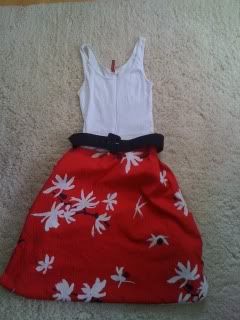
Here was my basic idea:

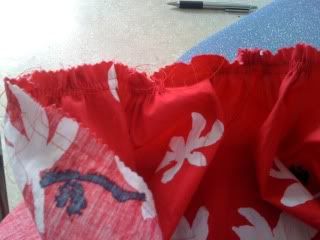
The skirt was too long for my liking, so sadly enough I had to trim the beautiful hand-hem job, but luckily it left me with enough fabric to create a waistband. First I hemmed up the skirt just by doing a basic stitch. It’s visible on the outside, but I don’t mind it. Then I basted the top of the skirt and created gathers like so:

When it was gathered to my liking (and I was still able to slip it over my hips), I secured the gather with one more stitch all the way around. After cutting a 3-inch waistband from the hem I sewed it to the top of the skirt, flipped it around, and sewed the band to the inside, creating a 3/4-inch waistband. I left part of the waistband open so I could push elastic through it. When the elastic was tight enough for my waist, I sewed it up and voila! A nearly perfect skirt — with pockets!

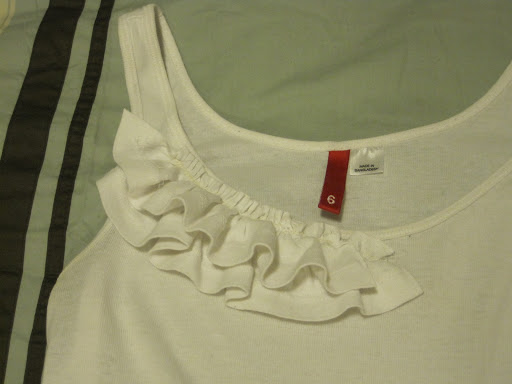
I was going to sew the tank top to the skirt, but then I decided not to because I may want to wear the skirt with other tops. I did take inspiration from the Alice Dress and I made ruffles out of the bottom of the tank. It was a long tank so I trimmed off the bottom 3 inches and hemmed the raw edge of the tank. With the 3-inch strip I basted the raw edge, made two ruffles and secured them to the collar of the tank. The other edge of the ruffles were already hemmed since that edge was originally the bottom of the tank. It was really easy. I need to do this more often. I felt like the craftiest person.

Here’s me out on the town with my new outfit: