Category Archives: Knit & Crochet

Baby Elf Hat — Free Pattern

This is Jack’s first Halloween. I’m not much of a Halloween person. I’m over it. I don’t need to dress like a sexy fill-in-the-blank. I’m not out to impress anyone. I was going to put forth some sort of effort with Jack since I have to address every single milestone in his tiny little life.

I dressed him up as a garden gnome, with a bib fashioned out of white felt to look like a beard and a pointy red hat. Here’s a poor-quality iPhone photo:

The hat is just too cute. I discovered after dressing him in green footie pyjamas that he also looks like an elf (no photo, unfortunately). This means the hat can double up for the holidays while I parade Jack around like the little elf child that he is.

The hat is pretty simple if you know how to knit hats. Here’s how I made it.

If you’re wanting to knit this pattern with a different needle size and different weight yarn, I am unable to adjust the pattern for you. This pattern is written for a specific needle size and yarn weight.

Materials:

1 skein worsted weight yarn

size 9 circular and double pointed needles

darning needle

Abbreviations:

CO = cast on

k1,p1 = knit 1, purl 1 ribbing

k2tog = knit two stitches together

Directions:

With your ciruclar needle, CO 64 stitches. Knit the last stitch to the first stitch making sure the stitches aren’t twisted on the needles. K1,P1 in the round for 6 rounds.

Knit regularly for 27 more rounds. Place marker at beginning of round. Decrease as follows:

k2tog, K6, repeat till end of round

k 1 round regularly

K2tog, K5, repeat till end of round

k 2 rounds regularly

K2tog, k4, repeat till end of round. Transfer stitches to double points

K 3 rounds regularly

K2tog, k3, repeat till end of round

K 3 rounds regularly

K2tog, k2, repeat till end of round

K 3 rounds regularly

K2tog, k1, repeat till end of round

K2tog, repeat till end of round

Cut yarn leaving an 8-inch tail. With a darning needle, weave in all ends. You can alter the pointyness of the hat by knitting more or fewer rounds between the decrease rounds. I like the cupie-doll look.

Striped Baby Hat — Free Pattern

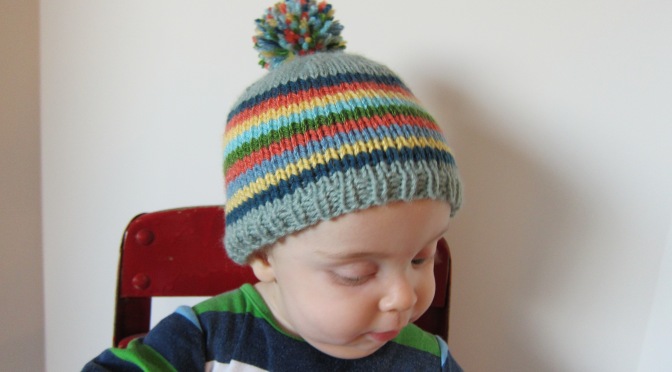
I swear there are Borrowers living in our house. They have possibly shacked up in our entryway, but I’m pretty sure they have borrowed four pacifiers, two house keys, some rubber stamps and the new hat I just knit for baby Jack.
So here I am at home on a Monday because Jack is sick. I’ve succeeded in making breakfast and putting him down for a nap. I have failed in getting dressed.

Other success — new hat!

Baby Striped Hat

Here’s how you can make your very own baby hat with stripes.

If you’re wanting to knit this pattern with a different needle size and different weight yarn, I am unable to adjust the pattern for you. This pattern is written for a specific needle size and yarn weight.

Materials:

Leftover worsted weight yarn. You really don’t need much. Up to six colors.

Size 9 circular and double pointed needles

darning needle

large fork for pom-pom

Abbreviations:

k1, p1 = knit 1, purl 1 ribbing

k2tog = knit two stitches together

Baby Striped Hat 2

Directions:

With your circular, cast on 64 stitches and knit last stitch to first stitch without twisting the stitches. K1, P1 for five rounds with main color. Knit two rounds regularly. Cut yarn leaving a four-inch tail. Start knitting with new color. After a few stitches, loosely tie the ends of the two colors together. You’ll tighten this up later, but it’ll help to do this along the way. Knit 2 rounds of each color until you have knit 20 rounds, not counting the ribbing. Switch back to the main color and knit 7 rounds.

Decrease as follows:

Place a marker if you need to, but I can tell where the beginning of the round is based on the stripes.

K2tog, K6, repeat till end of round

Knit one round

K2tog, K5, repeat till end of round

K one round

K2tog, K4, repeat till end

K one round while transferring to double pointed needles. Or knit the round and transfer stitches — whatever’s easier for you.

K2tog, K3, repeat till end

Knit one round

K2tog, K2, repeat till end

Knit one round

K2tog, K1, repeat till end

K2tog, repeat till end.

Cut yarn leaving a long tail. With darning needle, weave in the tail from the beginning and end.

The inside of your hat should look pretty cool, with all sorts of colorful ends. Tighten all the knots you made and then double tie them. Don’t pull too tightly as you want the stitches on the outside to look uniform. Just play with the tension of the knots before double knotting. I then knot the yarn ends vertically to one anther, if that makes sense, and trim them. I don’t bother to weave these all in since I’m totally lazy about it.

For the pom pom:

Take all the colors of your stripes and wind them around a large serving fork. With a doubled piece of yarn about one foot long, tie the yarn around the middle tine and remove from the fork. Cut the loops and trim pom pom to your liking. Using a darning needle, attach to top of hat. To better secure pom pom, run the yarn back up through the pom pom and back down into the inside of the hat.

Simple Striped Winter Hat Pattern

Last night an anonymous viewer commented on an old blog post for a winter hat I made a couple of years ago. I didn’t provide a pattern, but now I will. This is my basic pattern for every winter hat I make without earflaps. (For my earflap hat pattern, click here).

I don’t decide on stripes til I get there on the hat, but my general rule for stripes is to start the first one after I’ve knit the same number of rounds that the ribbing is. So, if the ribbing is six rows, I knit six rows regularly and then start the color change.

Normally I make my hats about 32 rows tall including the ribbing before decreasing, so I try to leave the same number of rows as I did the ribbing after the stripes are over. This creates better balance with the hat. So as an example, my ribbing is six rows, then I knit six rows regularly, then do my stripe pattern for about 14 rows, then knit my original color for six rows, then decrease.

Also, this pattern is for a medium adult hat. To make it larger, add eight stitches. To make it smaller, subtract eight stitches and follow the pattern the same way. If you want it to be a baby hat, use lighter weight yarn and smaller needles. I will use the same pattern for a baby but use worsted yarn and size 7 needles, for instance. For instructions on how to change colors while knitting, just do a YouTube search because I’m sure there are good lessons out there.

Ok, ok here’s the pattern.

Simple Striped Winter Hat

If you’re wanting to knit this pattern with a different needle size and different weight yarn, I am unable to adjust the pattern for you. This pattern is written for a specific needle size and yarn weight.

Materials:

Chunky weight yarn

Size 10 circular and double point needles

darning needle

Abbreviations:

K2,P2 = knit 2, purl 2 ribbing

k2tog = knit two stitches together

Directions:

With your circular needle, cast on 72 stitches with your main color. Knit into the first stitch, being careful the stitches aren’t twisted.  K2, P2 for six rows. Knit six rounds regularly. Add in second color. Alternate your stripe pattern for 14 rows. Switch back to your original color and knit six rows. Your work should be about 6 inches tall before continuing (for an adult size).

Decrease as follows:

Round 1: Knit two together, knit 6. Repeat for one round.
Round 2 (and all even rounds): Knit
Round 3: K 2 tog, K 5 for one round
Round 5: K 2 tog, K 4 for one round (this is where you should probably switch to the double points).
Round 7: K 2 tog, K 3
Round 9: K 2 tog, K 2
Round 11: K 2 tog, K 1
Round 12: K 2 tog
Gather remaining stitches with a darning needle and fasten off. Weave in all tails.

Pom-pom: I use a pom-pom maker I purchased from a fabric store, but I found a neat idea on Pinterest, here.

Knitting From the Past

Crochet a Flower Headband
Simple Crochet Flower
Jazz Baby Hat
Heart Garland
Crochet Baby Booties
Baby Beckham Set
The Tiniest Steelers Fan
Cheery Winter Set
Braided Winter Headband
Chunky Braided Winter Headband
Cabled Tapered Headband
Classic Ear Flap Hat
Cabled Gauntlets
Chunky Fingerless Gloves
Chunky Reknit Mitts
Ascot
Super Quick Owl Hat

Crochet a Flower Headband

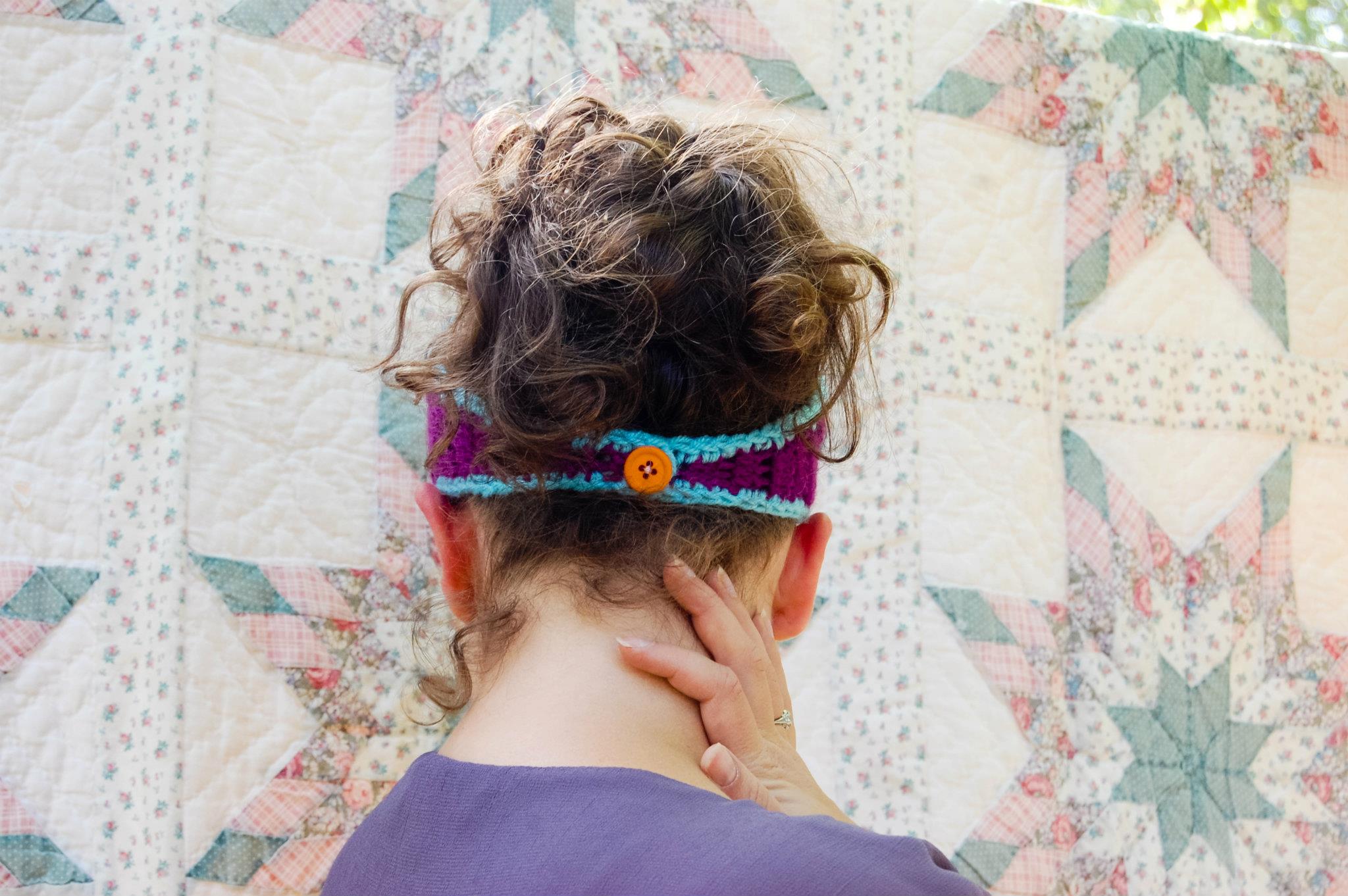
At long last I have finally caved into mainstream fashion and I’ve gone and made a flowered headband. You know the ones — tapered with a big flower on the side? They are cute, don’t get me wrong, but I was never into knitting them and then I realized the other day — I was never into KNITTING them. But what about crochet?

I actually admire Knitty.com’s Calorimetry Headband. I’ve made it before, although slightly altered because I feel as though it’s too wide for my head.

But honestly, I hate purling. All you do is knit 2, purl 2 for the whole pattern and it’s enough for me to stay away.

Last weekend I set out looking on Ravelry for a simple crochet headband pattern. I ended up finding a crocheted version of the Calorimetry Headband. As a knitter by nature, I needed a crochet pattern I could understand. This one was simple and best of all, much quicker than knitting.

I decided to take this basic pattern and embellish it with a border and a flower. Pizzazz!

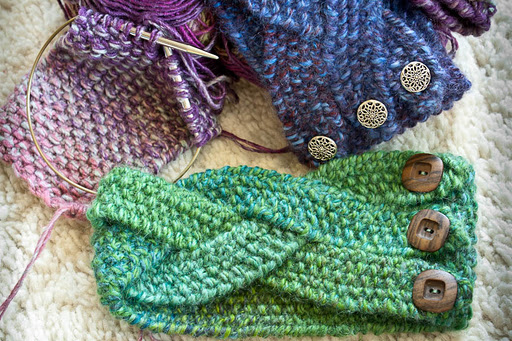
Tapered flower headband | A Free Crochet Pattern from Alaska Knit Nat
© Laura Stennett Photography


But I didn’t stop there. In case you don’t know me very well, when I get on a new kick I don’t stop. So I made five more. Then I decided to double the yarn and WOWEE it made it really pop. So I made four more.

Tapered flower headband | A Free Crochet Pattern from Alaska Knit Nat
© Laura Stennett Photography
Tapered flower headband | A Free Crochet Pattern from Alaska Knit Nat
© Laura Stennett Photography


And choosing the button in the back is half the fun!

© Laura Stennett Photography

So how are these pretty headbands made? LET ME TELL YOU!

First, I followed the instructions here but I used a J hook instead. I also think doubling up the yarn is much nicer, but that’s up to you. If you only have one ball just make another ball from it or use the end from the inside at the same time as the outside, if that makes sense.

Once you’ve completed the basic headband, with your contrast color start making single chains all around the outside of the headband. I didn’t put the hook into individual stitches, but instead I stuck the hook in the ch2 gaps at each end. When you’ve gone all the way around, slip stitch into the first SC and weave in all the ends.

View my previous blog post on how to crochet a flower. Then stitch the flower with a darning needle to wherever you’d like the flower to be. Pretty simple!

Tapered flower headband | A Free Crochet Pattern from Alaska Knit Nat
© Laura Stennett Photography
Tapered flower headband | A Free Crochet Pattern from Alaska Knit Nat
© Laura Stennett Photography


How to Crochet a Simple Flower

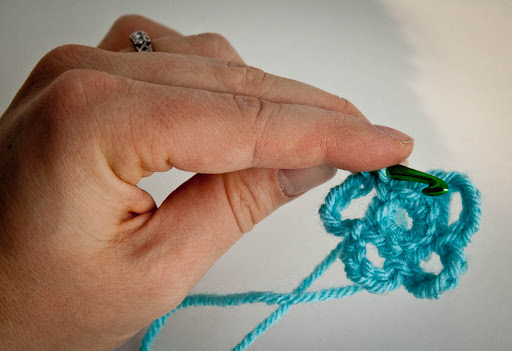
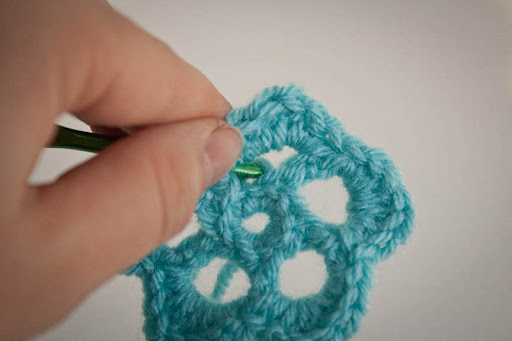
Ok, I did a less-than-adequate job of explaining how I crocheted a flower for the baby hat I knitted yesterday, so I decided to take some photos in the hopes that it’s a bit more clear.

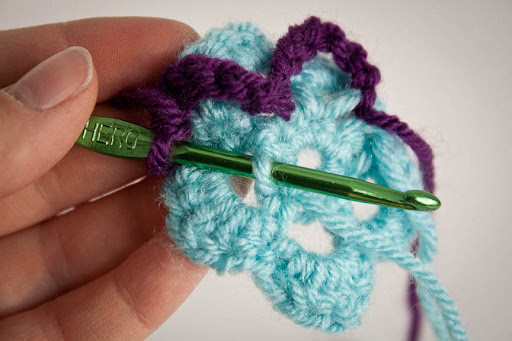
I used two different colors so the steps are easier to follow. Please keep in mind that although I crochet lefty, the steps are still the same, just reversed.

Materials:
Worsted weight yarn
size G or H crochet hook

Abbreviations:
SC = single chain
HDC = half double chain
DC = double chain

Click on photos to enlarge.

Step 1:
Make a magic circle and make 10 SC stitches into it. Draw the circle in tight and slip last stitch to the first SC.

Step 2: *Chain 5, skip a stitch, slip into the next stitch. Repeat * to end of round and slip in first ch of the round. You should have a sort of mini flower right about now.

Step 3: In the first loopy area, *SC, 2HDC, DC, 2HDC, SC. Repeat * in the remaining four loopy areas.

Step 4: This is where I changed colors, but you could keep it the same color if you wish. Heck, it’s your flower! You’ll be working behind the petals you just created, making slip stitches into the SC stitches you made in step 1. First, slip stitch in first stitch so it stays in the back of the flower. Next, slip into the next stitch. *Chain 8, skip a stitch, slip into next stitch. Repeat * till end of round. Slip next stitch to the first SC. You should now have five more loops behind the first set of petals.

Step 5: In the first loopy area, *2SC, 2HDC, 3DC, 2HDC, 2SC. Repeat * for the next four loopy areas, thus making five more petals that are offset from the first layer of petals. Slip next stitch to the first SC.

Step 6: Cut yarn leaving a 10-inch tail and draw through the remaining loop. Weave in all ends with a darning needle.

I hope this makes more sense for you!

Jazz Baby Hat

My friend Blaze is about two weeks ahead of me in her pregnancy. She had a boy last year she named Lyric and she’s getting ready to have a girl whom she is calling Jazz. Can you guess she’s a singer? 

With a name like Jazz I thought I should knit her a baby hat with some real flair. None of this pale pink stuff — I’ve got to go purple and red!

And I’ve finally learned to crochet a flower. This was the original reason I taught myself to crochet and that was almost two years ago. I now have the skills to make one without referring to a pattern. I will try to write out how I made it.


Materials:
Worsted weight yarn (I used Vanna White yarn)
Size 8 double point needles (or a really long circular if you know the Magic Loop method)
Size H crochet hook (it could be smaller, but I only have two sizes)
Darning needle

Directions for hat:
Cast on 64 stitches. K1, p1 ribbing for 5 rounds
Knit in stockinette stitch for 25 more rounds, or till piece is about 4 inches tall.
Decrease as follows: *K2tog, k6*, repeat till end of round.
K 1 round
*K2tog, k5*, repeat till end of round.
K 1 round
*K2tog, k4*, repeat till end of round.
K 1 round 
*K2tog, k3*, repeat till end of round.
K 1 round
*K2tog, k2*, repeat till end of round.
K 1 round
*K2tog, k1*, repeat till end of round.
*K2tog*, repeat till end of round.

 
Cut yarn leaving a 12-inch tail. Weave ends through remaining eight loops using a darning needle. Weave in end yarn.
 
Crochet flower: 
I apologize for my poor pattern writing skills. I hope you are able to figure it out! Maybe tomorrow when I have daylight again I’ll take step-by-step photos.
 
Abbreviations:
SC = single crochet
HDC = half double crochet
DC = double crochet
Round 1: Make a magic ring and SC 10 stitches into ring. Join with slip stitch to first SC. 
Round 2: Chain 5, skip a stitch, slip into next stitch. Repeat four more times and join to first SC again. You should have five loopy things.
Round 3: SC once into first loopy area, then 2HDC, 1DC, 2HDC and 1 SC into same loopy area. Repeat with four remaining loops. Join to original SC.
Round 4: Skip one stitch from the first round and slip stitch into the stitches between the ones you single chained in round 2. Chain 8, skip stitch, slip into next stitch, chain 8, skip stitch, continue around till you have five new loopy things. Join with first slip stitch you made in this round.
Round 5: 2SC into first loopy, 2HDC, 3DC, 2HDC, 2SC into same loopy thing. Repeat with the remaining four loopy things. Cut yarn leaving a ten-inch tail and draw through the last loop. Weave in ends to back of flower. 
Using a darning needle sew the flower in place.


Heart Garland

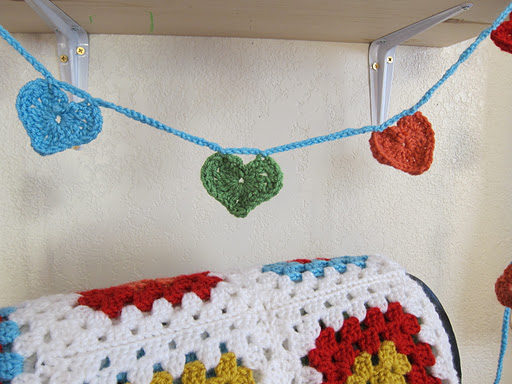
My little sister’s best friend had to move away from home for medical reasons so I thought I might send her some cheer for her new temporary home.

I found a great pattern for crocheted hearts here. I only ended up doing the first two rows and they worked for me just fine. They went by so fast that I didn’t even realize how many I had made by the time the TV show I was watching was over.

Hopefully this garland isn’t too granny-ish for her, but I almost wanted to leave them up at my house. I can always make more!

Chunky Braided Winter Headband

Last year I posted a pattern for a braided winter headband. After making one for myself, my mom and my little sister I soon realized it was the most popular knitted item I’ve ever created. The problem is, I’m really lazy and unless I’m determined, I really hate making these headbands. It’s simple, any beginner knitter could do it, but it takes too long and I lose interest.

I decided to try the pattern on larger needles with thicker yarn. Turns out I actually prefer the pattern this way. It goes by much more quickly and the texture stands out more strongly.

I’m still pretty lazy and can’t get myself to produce enough to sell, but I thought I might as well post my pattern so I don’t forget how I made it (hence the whole reason I started this blog in the first place).

If these instructions aren’t clear enough, you can always look at my other pattern for a slightly different explanation.

If you’re wanting to knit this pattern with a different needle size and different weight yarn, I am unable to adjust the pattern for you. This pattern is written for a specific needle size and yarn weight.

Materials:
2 skeins of worsted weight yarn (you’ll be knitting them together) OR one skein of bulky yarn
size 10 double point needles
darning needle
three attractive buttons
needle and thread
straight pins

Directions:
Using two double point needles, cast on 24 stitches. Knit in seed stich (also called moss stitch) till piece measures 12 inches. I always slip the first stitch of each row to keep the edge even.

*Next row: seed stitch the first 8 stitches onto an empty double pointed needle. Work back and forth on this “leg” for 12 inches.
Next row: k2tog, seed st. 3 stitches, k2tog
Next row: K2tog, k2tog
Bind off next row*

Repeat * for each of the two remaining “legs” of the headband.

Finishing:
Weave in the first tail of yarn.

Braid the three “legs” of the headband till there’s about 2 inches left at the ends. Pin the three ends to the beginning of the piece, creating the headband shape. Make sure the ends overlap the beginning of the piece so there’s a good amount of space for the size of your buttons.

Pin the braid in place. With the darning needle, secure each end in place using the tails from the “legs.”
Turn headband inside out. With needle and thread, whipstitch parts of the braid so the “legs” are secure and don’t move or twist apart when stretched.

Sew on your buttons.

Granny Blanket for Baby

Finally, after more than a year of teaching myself to crochet, I have made something substantial. All it took was being pregnant!

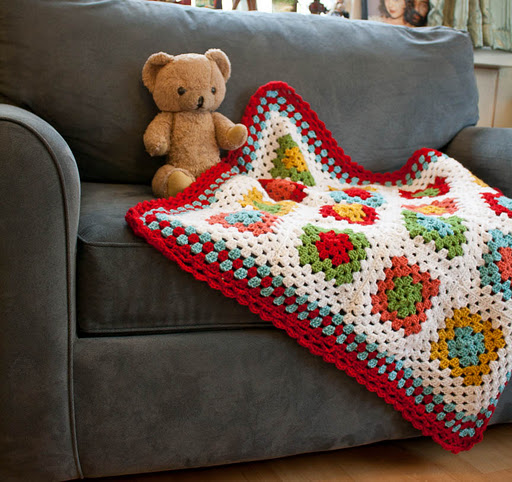
Baby Blanket pictured with Beary, my older sister’s favorite bear

I crocheted a blanket using the classic granny square technique. I used Lion Brand Vanna White yarn. I love the colors and it’s super cheap at JoAnn Fabrics, although I had to go to Michael’s for the blue color. They have better baby yarn selection with the Vanna White yarn.

I think the blanket cost about $35 and it took me just a week to make. My granny squares were about 6 inches so I didn’t need to make too many to make a substantially sized baby blanket. Just 16 squares, four rows of a border and a simple trim and it was done before I knew it. Joy!

I had never stitched together granny squares, although I’ve made quite a few in a failed attempt to make a blanket last year.

I just love Attic24‘s colorful, detailed instructions on all things crochet. Her blog was my inspiration to learn crochet.

Click here for a great tutorial on stitching together squares.

Click here for simple border and trim instructions (she uses UK terminology but translates it for us Americans).

I think the trim will be good for when baby is able to grab things because it feels nice between your fingers.

Overall, this blanket was a success, but I think I stitched the squares together too tightly because they poof out in the middle and doesn’t lie quite flat.