Category Archives: Patterns

Left-handed hat video tutorial

My husband’s mom, I recently discovered, knits left-handed like I do. She knows how to make scarves and blankets, but she wanted to learn something new. Since I don’t spend much time up in Fairbanks, AK (I like things to be above -33 degrees), I decided to make a video tutorial. iMovie rocks!

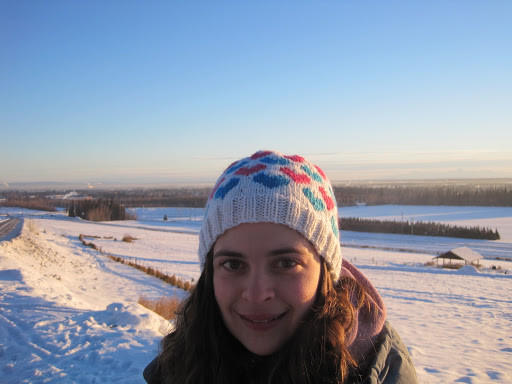
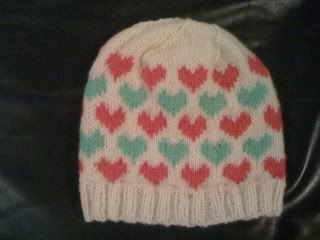
My Heart Goes out to Fairbanks Hat

This is one of my loveliest hats to date. It’s based closely on the From Norway With Love pattern from www.pickles.no.

I first followed Pickles’ pattern exactly, but I must have bought too thin of yarn because it turned out baby.
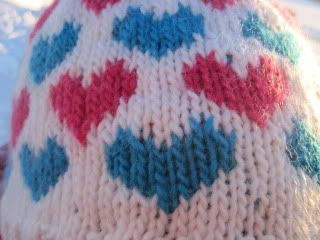
It is a very very cute baby hat, but I wanted one for me! So I went with my gut, which I should have done in the first place, and tweaked the pattern to fit my own hat patterns. The biggest problem I had with Pickles’ pattern was the heart chart. When I thought less about the chart, the hearts turned out perfectly. I used the chart as a guide for where to place the hearts and how many stitches they were made of, but I stopped counting row by row and it worked out better. Somehow her chart didn’t seem quite right.
The hat is made in sets of 10 stitches. The base of the heart (one stitch) occurs every 10 stitches, so when you start the first row of hearts, start the pattern by knitting 4 in the main color, k1 in the heart color, k9 in the main color, k1 in the heart color, k9 in the main color, k1 in the heart color and so on. When you get all the way around you’ll see your first heart color stitch. With the heart color, k1 before that stitch, k1 on top of that stitch, and k1 after that stitch. Row by row you add one heart color stitch on either end of the heart till there are 7 stitches (so, 1, 3, 5, 7). Knit two rows of 7 heart stitches and then the rest of the heart chart will make sense.
Once you’ve finished the first row of hearts, you immediately start the second row by knitting 9 in the main color, K1 in the 2nd heart color, 9 in the main color and so on. Basically the heart pattern alternates every 5 stitches so they fit in between each other.
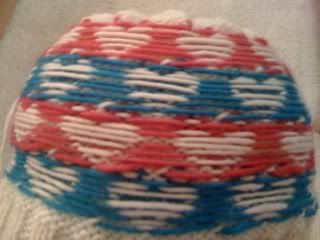
This pattern is a great introduction to Fair Isle patterns because you carry the unused colors along with you as you knit. In other words, if you knit 4 stitches in the main color and then switch to the heart color, you carry the heart color on the inside of the work. Here’s what the hat looks like inside out:
The most difficult thing about knitting hats like this is making sure to keep the unused yarn loose in the back of the work. If you carry over the yarn too tightly, your hat will be super scrunched up and won’t fit over your head. My solution to this is when I’m carrying yarn over more than three stitches, I place my finger under the yarn so it leaves a gap and knit a couple of stitches with my finger in place behind the work. It might look really loose, but it will tighten up when you wear it. If you’re carrying the yarn over 1-3 stitches, just try not to knit very tightly. It just takes practice, so you might end up knitting a beautiful baby hat for someone.
Whew! At long last, here is the pattern
My Heart Goes Out to Fairbanks Hat
Ingredients:
Size 7 circular needle, 16″ long
2-5 colors of Lamb’s Pride worsted yarn, one skein each
one set of size 7 double points
darning needle
Important Abbreviations:
MC = Main Color
HC1 = Heart Color 1
HC2 = Heart Color 2
K2tog = knit two stitches together
Heart Chart:
Note: I honestly believe the tan heart in this pattern is not correct. The second row from the top, on the far right, that should be a white square, not tan
Directions:
With MC, cast on 100 stitches. Place a marker and connect the round without twisting the yarn. K2, P2 for two inches, or till brim is a width of your liking.
K 2 rows
Next row: With MC, K4 stitches. *With HC1, K1 stitch. With MC, K9 stitches.* Repeat * till you get back to the place marker.
Next row: With MC, knit to two stitches before the first HC1 stitch. *With HC1, K3 stitches. With MC, K7 stitches.* Repeat * to end of row. (NOTE — this is a very visual project. It’s hard to write out the directions. Just keep in mind that once you see the first stitch of the heart, that you’ll be expanding the size of the heart in the following row. My written instructions may not be exactly correct.)
Next row: With MC, knit to two stitches before the previous row’s first HC1 stitch. *With HC1, K5 stitches. With MC, K5 stitches.* Repeat * till end of round.
Next row: With MC, knit to two stitches before the previous row’s first HC1 stitch. *With HC1, K7 stitches. With MC, K3 stitches.* Repeat * till end of round.
Next row: With MC, knit to the stitch before the previous row’s first HC1 stitch.  *With HC1, K7 stitches. With MC, K3 stitches.* Repeat * till end of round. (This row you aren’t expanding the heart. You are knitting the same heart stitches as the previous row.)
Next row: With MC, knit to one stitch before the previous row’s first HC1 stitch. *With HC1, K3. With MC, K1. With HC1, K3. With MC, K3.* Repeat * till end of round.
Next row (top of heart): With MC, knit to one stitch before the previous row’s HC1. *With MC, K1. With HC1, K1. With MC, K3. With HC1, K1. With MC, K5.* Repeat * till end of round. Cut HC1 leaving an 8-inch tail.
Immediately the next round: *With MC, K9. With HC2, K1.* Repeat * till end of round. Follow the same instructions above for creating the HC2 hearts. Refer to the chart, keeping in mind it’s flawed in the second to the last row from the top of the heart.
Create 4 sets of heart patterns. Make 5 sets if you want a tall sort of floppy hat.
K 2 rows using the MC yarn.
Decrease pattern:
First, you need to change your hat to be in multiples of 8, so in the next row, K2tog four times somewhat evenly through the row. Every 20 stitches or so I K2tog. You won’t be able to notice this row in the end. You should end up with 96 stitches.
Next row: *K2tog, K6.* Repeat * till end of row.
Next row: K one round
Next row: *K2tog, K5.* Repeat * till end of row.
Next row: K one round
Next row: *K2tog, K4.* Repeat * till end of row.
Next row: K one round
Next row: *K2tog, K3.* Repeat * till end of row.
Next row: K one round and transfer to double points while knitting this row.
Next row: *K2tog, K2.* Repeat * till end of row.
Next row: K one round
Next row: *K2tog, K1.* Repeat * till end of row.
Next row: K one round
Next row: *K2tog.* Repeat * till end of row.
You should have 12 stitches. If you have 24, repeat the last round again.
Cut yarn leaving a 12-inch tail and loop through the remaining stitches. Cinch it up and weave in the ends. I tied the heart color ends together and snipped them instead of taking all the time to weave them in.
 

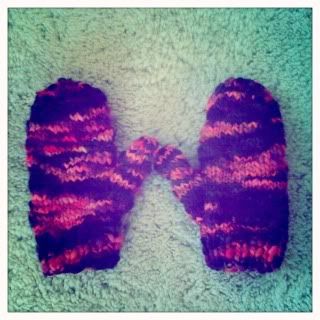
Reknit Chunky Mitts

In case you don’t know me, I’m somewhat of a thrift store guru. For instance, yesterday I found $378 Frye boots at the SPCA Thrift Shop for $70 and I talked them down to $20. In addition to that brilliant find, I also found a 50 cent scarf that I thought would look better as mittens.

I made up this pattern, but I would only use it for irregularly shaped yarn like the kind I used because otherwise the top of the mitten might come out with gaps (it’s not mathematically sound). But it sure knits up fast!

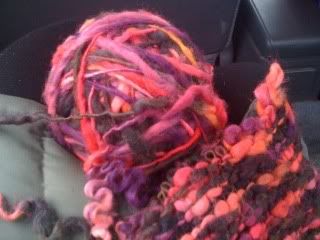
Scarf being unraveled

Chunky Mitts
Ingredients:
1 thrift store scarf, about five feet long, unraveled and wound into a ball
four size 10 double points
scrap yarn
darning needle

Useful Abbreviations:
M1FB — make one stitch in the front and one in the back of the same stitch, thus increasing your work by one stitch.
M1 — Make one stitch between two stitches
K2tog — knit 2 stitches together

Cast on 24 stitches (8 on each needle)

K1, P1 for 10 rows
Next round: knit the first needle, M1FB into the last stitch of the first needle. On second needle, knit 4 stitches and M1FB into the next stitch. M1FB into the last stitch of the second needle. On third needle, knit 4 stitches and M1FB into the next stitch. Knit to end of needle — 28 stitches.
Knit 3 rounds
Round 15: M1, K1, M1, knit to end of round
Round 16 and all even rounds: Knit to end of round
Round 17: M1, K3, M1, knit to end of round
Round 19: M1, K5, M1, knit to end or round
Round 21: M1, K7, M1, knit to end of round
Knit 3 rounds
Next round: Transfer the first 9 stitches onto some scrap yarn. Cast on one stitch and knit to end of round.
Knit until work reaches the top knuckle of your middle finger
Next round: *K2tog, K3* repeat * till end of round, where you will K1 stitch on the third needle.
Next round: Knit
Next round: *K2tog, K2* repeat * till end of round, ending with K2tog.
Next round: Knit
Next round: *K2tog*, repeat till end of round.
Cut work leaving an 8-inch tail. Weave in all ends.

Thumb:
Transfer the 9 stitches onto two needles. With third needle, pick up 4 stitches. Knit around and K2tog two times evenly throughout the work so as not to leave gaps in the crotch of the thumb. You should have 11 stitches. Knit around till just the tip of your thumb barely peeks out.
Next round: K2tog all around, ending with a K1. Cut yarn leaving a tail and weave in ends.

Repeat with second mitten.

Chunky Ascot Pattern

As you may have gathered, I’m all about knitted ascots. I’m also extremely lazy and I have a hard time concentrating on a project I can’t finish in a few hours. I wanted to make an ascot on bigger needles. It would take less time and would probably have a different look (less grandma-ish).

I used inexpensive Lion’s Brand chunky tweed and it only took me a couple of hours.

Ingredients:
1 ball of chunky yarn
3 size 10 double point needles
darning needle
decorative button (optional)

Abbreviations:
M1FB — make 1 stitch in the front and 1 stitch in the back of the same stitch, thus increasing the piece by 1 stitch

Directions:
Cast on 2 stitches. M1FB of the first stitch, K the next stitch.
Continue to M1FB of the first stitch of every row till you have 16 stitches.
K 12 rows in garter stitch. I slip the first stitch of every row to keep the rows neat and even.
Next row: *Knit the first stitch, transfer the second stitch to the third double point needle.* Repeat * to end of row. You should have 8 stitches on each needle.
Starting with the needle that still has yarn attached to it, K1, P1 for 9 rows. Cut yarn, leaving a 6-inch tail.
With the other needle holding 8 stitches, leave a 6-inch tail and K1, P1 for 9 rows, but don’t cut the yarn when done.
Next row: *Knit the first stitch from both the front and back needles together, then knit one from the front and one from the back.* Repeat * till there is 1 stitch on each needle. Knit these two stitches together. You should now have 12 stitches on one needle.
Knit in garter stitch till the work is long enough to go around your neck and touch the loop you just created.
Next row: *K1, K2tog* Repeat * to end of row. You should now have 8 stitches again.
K1, P1 for 9 rows.
Next row: M1FB in each stitch. You should now have 16 stitches.
Knit in garter stitch for 12 rows.
Next row: Knit the first 2 stitches together, K to end of row
Repeat the last row till there are 2 stitches remaining.
Bind off. Weave in tails. Sew on decorative button to one side of the loop if you desire.

Chunky Fingerless Mitts

These fingerless mitts are a Knit Nat original. They knit up quickly — perfect for the short attention span crafter.

Chunky Fingerless Mitts -- Free Pattern from Alaska Knit Nat

Ingredients:
Size 10 double point needles
One skein of Lion Brand Tweed Stripes in Caribbean.
Chunky scrap yarn
Darning Needle

Abbreviations:

  • M1FB – Make 1 stitch in the front and back of the next stitch, thus increasing the work by 1 stitch.
  • M1 – Make 1 stitch between two existing stitches.
  • K2tog – knit two stitches together

Directions:
Using 3 double pointed needles, cast on 26 stitches (8, 9, 9)
K1, P1 rib for 13 rows or until the cuff is as long as you desire
Round 14: K4, make 1 stitch in the front and back of next stitch (M1FB). Knit to last stitch on needle and M1FB again. K4 on the next needle and M1FB. Knit to end of needle. K4 on the third needle and M1FB. Knit to end of needle. You have increased the row by 4 stitches and should now have 30 stitches.
Knit 3 rounds
R18: M1, K1, M1, knit to end of round
All odd rounds: K one round
R20: M1, K3, M1, knit to end of round
R22: M1, K5, M1, knit to end of round
R24: M1, K7, M1, knit to end of round
R26: M1, K9, M1, knit to end of round
Knit 4 rounds
Transfer the first 11 stitches to a piece of scrap yarn.
Cast on one stitch. You should now have 30 stitches again.
Knit 6 rounds
K1, P1 rib for 4 rounds
Loosely bind off

Thumb:
Transfer the 11 stitches to two double pointed needles. With third needle, pick up and knit 4 stitches (make sure you leave at least a 6-inch tail of yarn). Knit one round. When you get back to the picked up stitches, K2tog twice, leaving you with 13 stitches total. Knit 5 rounds or till thumb is the length you prefer (you can try the mitt on at this point).
Bind off. Weave in tails. At the crotch of the thumb, use the extra tail to sew up any gaps.

Here is a pair I made with two kinds of worsted yarn knitted at the same time. They turned out really stiff and a little too big for my hands. They fit Stephen’s perfectly, but they weren’t his colors.

Crocheted Ornaments

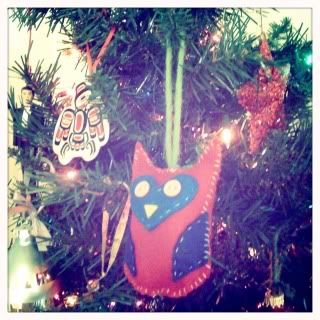
Never did I think crocheting would look attractive, especially in Christmas ornament form. I guess it all depends on the yarn, but I’ve been having fun making these. I’ve included my pattern below, but if you want a real pro’s pattern, visit my favorite crochet artist’s  Ornament Tutorial.
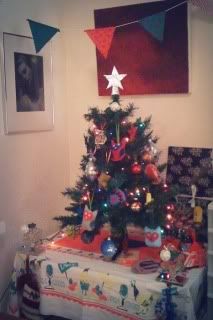
Here’s our little tree.

I don’t know what size hook I used, nor do I know how to write crochet patterns, but here’s sort of how I made them.

Make 2 of the following pattern:

Round 1: Chain 5 and form into a loop. Chain 2 and DC into loop 11 times (12 spokes). Join to 2nd stitch of first chain. Bind off.
Round 2: Between two of the spokes, bring in new color and Chain 2. DC once into the same space, DC twice in every other chain space (24 spokes). Join to 2nd stitch of first chain. Bind off.
Round 3: In a space between two sets of two spokes, bring in new color and chain 3. DC twice more into same space, skip 2 spokes and DC 3 times in the bigger space. Repeat till end of round. Join to 3rd stitch of first chain. Bind off. (If making a small size, skip to round 5).
Round 4: In space between two sets of three spokes, bring in new color. Chain 3 then DC three times into same space. Skip next 3 spokes and DC four times in the bigger space. Repeat till end of round. Join to 3rd stitch of first chain. Bind off.
Round 5: With wrong sides facing from both circles, join with new color by inserting hook into an outer stitch of both circles and pulling yarn through to the front. Single chain each stitch (not in between the spokes like the other rounds, but into the stitch on the outside of the round). Make sure to go through both circles with each single chain. Repeat SC till there’s about 2 inches of open space left between the two circles. Place a little bit of stuffing inside till it’s stuffed to your liking. Finish off the SC border. Join to first stitch of the round then chain for 4 inches to make a loop. Join to the beginning of the chain. Weave in ends.

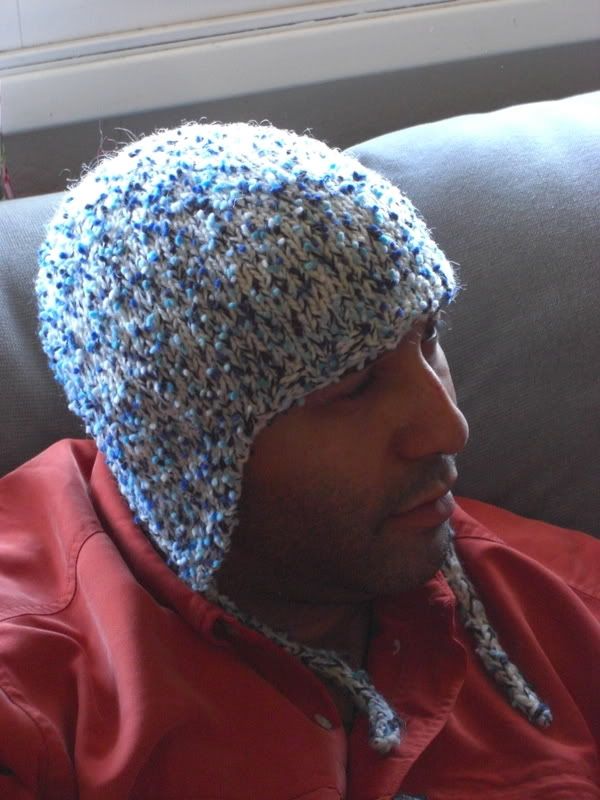
My Classic Ear Flap Hat

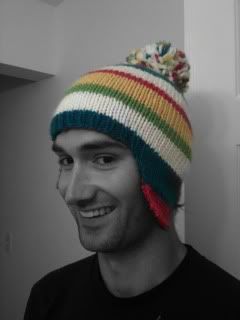
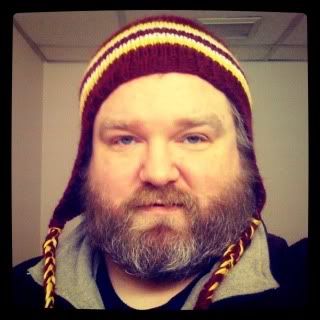
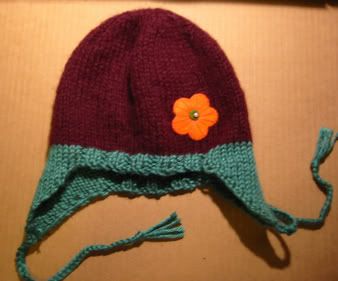
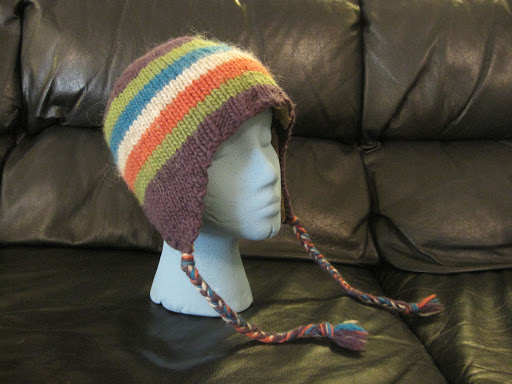
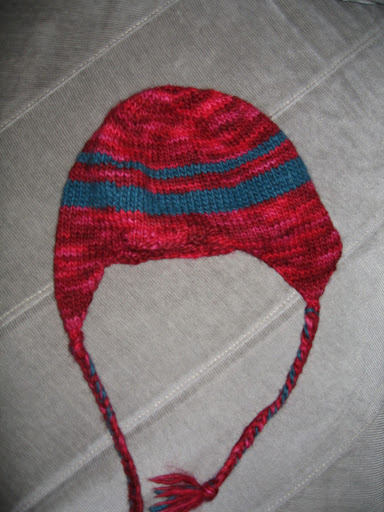
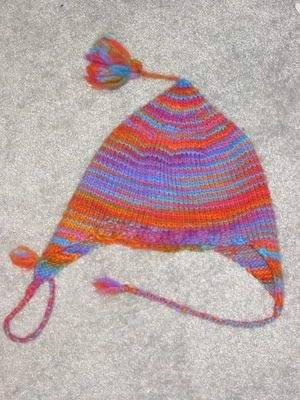
This pattern is my tried and true hat design. A spin-off of Far North Yarn Co.’s Alaska Ear Flap Hat, I have made probably about 50 hats over the past 7 years. Here is my pattern along with several photos of different hats I’ve made. I make the size small for an average head. That’s 72 stitches total.

If you’re wanting to knit this pattern with a different needle size and different weight yarn, I am unable to adjust the pattern for you. This pattern is written for a specific needle size and yarn weight.

Sizes XS, S, M, L

Ingredients:
Size 9 or 10 circular and double point needles
1 skein bulky yarn. I love Lamb’s Pride.
Tapestry Needle
Pom pom maker (optional)

Ear flap (make 2):
With two double point needles cast on 2 stitches. Purl 1 row. Work back and forth in stockinette stitch. Every time you do the knit side (right side), increase in the front and back of the first and last stitch. This will create the triangle shape. Keep going until there are 16 stitches for the XS, 18-S, 20-M, or 22-L. Place these stitches on a holder. 

Hat: With the circular needle, cast on 12-XS, 14-S, 16-M, or 18-L stitches for the back of hat; knit across stitches of the first ear flap making sure the right side is facing you. Cast on 20-22-24-or 26 stitches for the front; knit across second ear flap. There will be 64-72-80-or 88 stitches in all. Join stitches carefully without twisting. Knit 2 purl 2 on the front and back part of the hat (regular knit the ear flaps) for four to six rounds. This will make the nice ribbing and will prevent the hat from curling up.

Continue knitting until the hat is about 5.5 inches tall. I usually go with 32 rows from the edge of the hat. 
Then start decreasing as follows:
Round 1: Knit two together, knit 6. Repeat for one round.
Round 2 (and all even rounds): Knit
Round 3: K 2 together, K 5 for one round
Round 5: K 2 together, K 4 for one round (this is where you should probably switch to the double points).
Round 7: K 2 together, K 3 
Round 9: K 2 together, K 2
Round 11: K 2 together, K 1
Round 13: K 2 together
Gather remaining stitches with a darning needle and fasten off. Weave in all tails.

I just braided yarn together to make the ties for the flaps. You could also do a cord stitch where you have three stitches on a doublepoint. Knit to end of row and instead of turning the work, just push them back up to the end so the yarn wraps around the back. Knit in this way till it’s long enough. Braiding is faster and pretty.

Sometimes I add a pom pom. This is especially nice when making a stripey hat because you can include all the colors in the pom pom and it’s faster to make than one color.


Here’s a montage of some of the hats I managed to take photos of before giving them away.


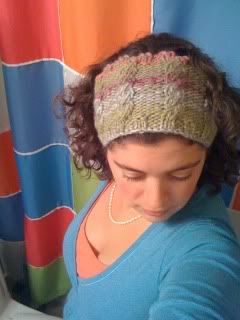
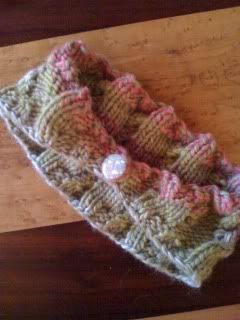
Cabled Tapered Headband

This pattern is based on the Calorimetry Headband at Knitty.com

We sell tapered cabled headbands at work and I figured I could probably make one. Here is the pattern!

Needles: size 10 circular
Yarn: Lamb’s pride bulky (I used two worsted weights together to create the color combo)

Cable pattern will be made on the wrong side of your work. 
Cable pattern: 
Row 1: K4 
Row 2: P4 
Row 3: C4F (transfer two stitches to cable needle and set in front of work. Knit the next two stitches then Knit the two stitches from the cable needle) 
Row 4: P4 
note: I don’t make the cable pattern on the outermost corners of the headband because there are so few rows.
CO 72 St. 
Row 1: K2, P2 
Row 2: K2, P2 to last two stitches. Turn work. 
Row 3: Slip 1 purlwise, P1, K2, place marker. P2, K2 to last two stitches. Turn work. 
Row 4: Remove marker. Slip 1 purlwise, P3, place marker. Start cable pattern: K4, P4 to marker. Turn work. 
Row 5: Remove marker. Slip 1, P3. Place marker. K4, P4 to marker. Turn work. 
Row 6: Remove marker. Slip 1, K3. Place marker. P4, C4F to marker. Turn work. 
Row 7: Remove marker. Slip 1, K3. Place marker. P4, K4 to next marker. Turn work.
Continue rows 4-7 till there are five groups of four stitches on the outside of the stitch markers (22 stitches). *If you want a narrower headband, knit until there are 18 stitches on the outside of each stitch marker.*
Row 8: When both sides have 22 stitches, start the next row without removing the stitch marker and knit in the cable pattern to the next marker. Turn work. 
Row 9: Without removing the stitch marker, continue in the cable pattern to the next marker. Remove marker and knit the next four stitches according to the cable pattern. Turn work. Place marker.
Row 10: Place marker and knit in cable pattern to next marker. Remove marker and knit 4 stitches according to cable pattern. Turn work. Place marker.
Continue Row 10 till there are only two stitches on the outside of both markers. 
Row 11: P2, K2 removing all markers 
Row 12: K2, P2 removing all markers
Row 13: BO in ribbing pattern (K2, P2) 
Weave in ends. Sew on a button to one corner. There should be a hole you can put the button through easily.

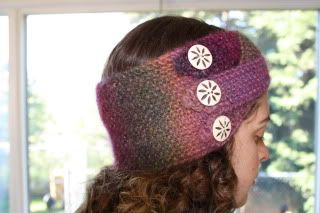
Braided Winter Headband

Never have I received more comments and compliments on a knitted piece of mine. It was selected as a featured knitting project for October on craftster.org

I adore this headband, but I only wish I could knit seed stitch faster. I wrap my yarn instead of grabbing? I’m not sure. I knit the other method than most people so I’m slower with switching from knit to purl.

This headband is a simple construction. I did not come up with the pattern. I spied on someone in Seward who was wearing it and figured out how to make it.

Ingredients:
Size 7 straight needles and double points
darning needle
worsted weight yarn
three buttons
needle and thread


Directions:Cast on 24 st. 
Knit garter stitch for three rows
Knit in seed stitch for 10 inches. I slip the first stitch of each row to make an even edge.
At ten inches, *transfer 8 stitches to a double point needle and continue seed stitch pattern for another 11 inches. 
To make a tapered edge, knit the first two stitches together, continue the seed stitch, then knit two last stitches together (6 st). 
Seed stitch the next row.
K2Tog, seed st, knit last two stitches together (4 st).
Knit the next row
CO and leave a 12″ tail.*
Repeat ** for the remaining stitches. It should look something like this:


When you have all three strips finished, braid them, pinning the overlapping parts in place how you like them. With the yarn tails and darning needle, sew the pointed ends to the beginning of the work, creating the headband.
With needle and thread, sew the pinned overlapping parts, making sure the thread doesn’t show through the front of the piece.
Sew on buttons.

Cabled Gauntlets

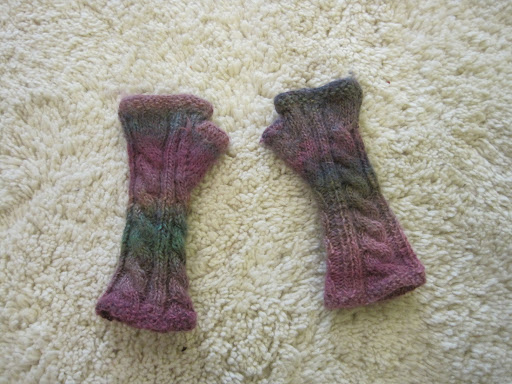
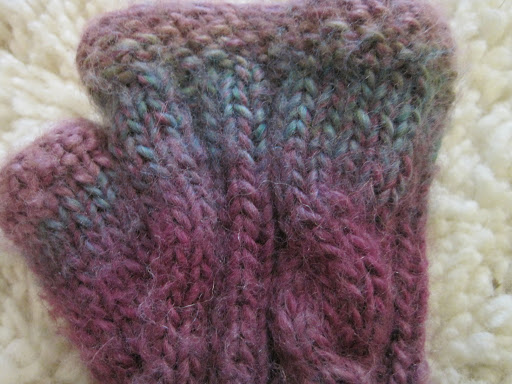
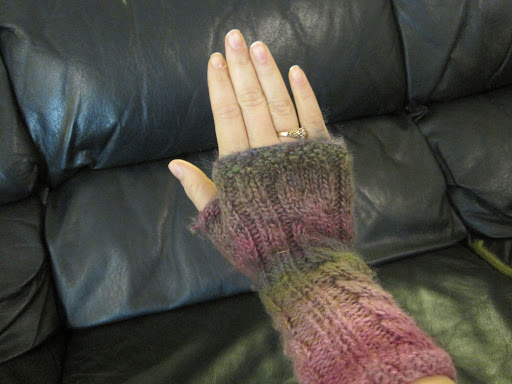
I really wanted to make fingerless gloves to match my headband, but I didn’t want to deal with the individual fingers. I found a pattern for cabled gauntlets, but I didn’t like the gusset design; so I merged my favorite mitten pattern with the cabled gauntlet pattern and came up with these:

Ingredients:
1 skein Universal Yarn Classic Shades worsted in Grapevine
Size 7 doublepoint needles
Darning needle
Waste Yarn


Cable round:
*K1, P2, slip 3 to cable needle and hold in back, K3, K3 from cable needles, P2, K1*

Cast on 36 stitches and divide them evenly on three needles (12 on each).
Knit 5 rows in seed st.
Rounds 1-6: *K1, P2, K6, P2, K1* repeat ** around (non-cable pattern)
Round 7: cable round

Repeat rounds 1-7 five times, or until glove is the right length for you

Repeat rounds 1-4 one more time

Part 2, the gusset:

Round 1: K1, P2, K3, make 1, K1, make 1, knit the rest of the round, continuing the cable pattern. Rearrange stitches so the M1, K1, M1 is at the end of a double point, not the middle.
Round 2 and all even rounds: K cable pattern
Round 3: M1, K3, M1, knit till end of round with cable pattern
Round 5: M1, K5, M1, knit till end of round with cable pattern
Continue in this method, making new stitches every other round, till you’ve reached
Round 11: M1, K11, M1 and knit till end of round with cable pattern. You may need to add another doublepoint.
*The non-gusset stitches pattern would look like this:
K 2 rounds in non-cable pattern
K round 7
K rnds. 1-7*
When the gusset is the right number of stitches, Knit 4 rows of non-cable pattern. The gusset should be knit in stockinette stitch.
Put the 13 gusset stitches on waste yarn
Cast on 1 stitch and K5 rows in non-cable pattern
Seed stitch 6 rows and cast off.

Thumb:
Transfer gusset stitches to three doublepoints. Pick up 2 stitches where the crotch of the thumb will be. You can pick up more than two if it will make fewer holes, just be sure to knit them together on the first round.
Knit 2 rounds
Seed stitch 2 rounds
Cast off

Weave in ends